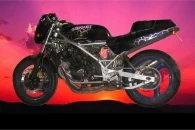
Now we can start on the thing that caused this rebuild: a broken windshield. As mentioned, a lot has to be done here:
- New headlights,
- new windshield,
- better fitting of instruments
This is what we start with:

I started with opening up the front of the fairing. Although the new lamps are round double units, I want to get an other look. To keep the fighter look, the opening should look like an air intake from some older jet plane's like the MIG's. The lamps should be as far back as possible, trying to hide them in the back. therefor I bought a set of relative small diameter lens lamps. Only problem is that these are relatively long.


So lets get dirty. This time no hacksaw but using the grinder. This gives more dust and noise but I'm not amused with the amount of saws the fiberglass needs.

More than enough hole... now filling it up.
This is the result of a couple of hours cutting, bending, drilling and fitting. The shape is relatively simple, only single curved sheet. Only need some attention on the fitting of the seams.
I'm pleased with the effect.Right now the bike is on a table of 50 cm high. I'm curious how "hidden" the lamps are when the bike is on ground level and you walk around it.
So the wooden block has to go of course. All the brackets and braces on the back have to be fabricated. I will start that when instruments and windshield are done.
Windshield.
The first piece of aluminum I tried was the right side of the shield. This was the go - no go item for the rebuild. When this double curved piece was looking acceptable I knew that I could pull this off. The problem of duplicating this on the left side was still there. But with the grown confident I started hammering.
Left and right side. One cut to size, one rough. I hope they like each other.. they will spend a lot of time in this configuration...
And of course fitting and checking as you go. The blue lines indicate that I decided for some more straight lines on the edges..more cutting and fitting.


Finished shield, front and back side. Only the front is sanded.
This is the start of the instrument cluster. Starting with a flat sheet.Making holes for the instruments. The nice thing of the aluminum sheet is that you are able to remove material with a file relatively easy.

To fit the reset wheel of the tacho, a relieve is made.
To prevent rattling a strip is attached in the middle. First step is making a nice row of holes.


Drill one hole, put the rivit in, drill next and fix the bracket. then start drilling the rest. You don't want to drill 12 holes on the wrong spot. The next time I do a project like this I get a set of cleco's.

View from the back of the panel. The white edge on the polyester marks the difference between the old screen and the new one. The new line is wider, more a match to the rest of the bike.

Meet the new face I will be looking at for the next ten years. What still missing is the surface treatment: brushing.
work to be done...stories to write...