/Garage/zombieclassics
| zombieclassics | ||
|
|
El Cerro, NM, USA Joined: 01/04/2010 |
|
Builder, Restorer, Old-School, Street Rodder, Custom Rodder, Build-It, Drive-It, Classics, Rat Rod, Off-Road
Ford Mustang "Karen Cooper"
|
Exploration
Posts:
Cleaning Part II
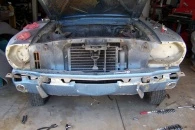
At this point in the project after a few delays that included redoing the guest bathroom for a new roommate, I am almost done cleaning and stripping the engine bay. The hood, fenders, steering and suspension have all been removed including the driver side door which will be replaced with a donor. I have encounter to two problems. One major and another one that can be repaired. The repairable problem is the top nut embedded into sheet metal for the passenger side hood hinge. This D nut has cut into the sheet metal and is no longer anchored but rather slides. The hinge itself is damaged and will need to be replaced but I discovered why the hood never closed flush at the cowl on the passenger side. The more critical issue has to do with driver side shock tower. One of the bolt holes for the upper control arm has been enlarged and out of round probably due to a loose nut at some point in the past. This probably played havoc on the steering and also explains why there were so many shims on that side. The only thing I can do is either replace the entire shock tower or relocate the bolt holes ala Shelby re-engineering. I will attempt to relocate the bolt holes but I will need to obtain the cheat sheet pattern that forgoes the math and measuring. Stripping the paint has proven to be quite a chore and I have used both chemical and mechanical means to achieve the end. There are a few spots that I want to finish before I start to primer. Thanks to the dry Arizona air I have not encountered any flash rust on the exposed metal.
Cleaning part 1
So this where I am at with the Mustang project. I decided to go with a bottom to top, front to back approach. The engine bay is almost completely bare and I have made a lot of progress on cleaning it. I have the driver side front fender off and have cleaned most of the debris, road tar, oil-dirt and seam sealer. I am pretty sure that this has never been done for this car, ever. I have uncovered the original factory yellow crayon markings on the frame. I decided after a bit of deliberation, to remove the seam sealer material since it was cracked and drying out. The areas where the cracks were, revealed surface rust and dirt so this was a good call. I have probably removed ten pounds of dirt and gunk so far and am not finished yet. This has been the hardest part of the project to date. Not as frustrating as removing the transmission but much more elbow grease. As I was cleaning the seam sealer I was thinking how what I would do to replace it. Lizard Skin, OEM type seam sealer or rubberized undercoating. I noticed that the thicker the seam sealer the more prone to cracking it had become.
289: original or not
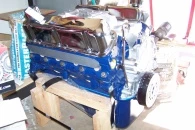
When I first bought the car I had decoded the VIN or warranty number enough to realize that the 2 barrel carburetor and intake manifold were not original. I was having problems with the carb so I decided to replace it with an Edlebrock 600 cfm 4 barrel and aluminum intake manifold. This definitely improved the performance. I really didn't think more about the engine itself. It ran well when I had parked it. So lately when I decided to rebuild the Mustang I originally had thought I would leave the engine as is. But after looking under the hood it looked terrible and I knew that I would at least like to rebuild the carburetor. I had bought a rebuilt 1975 C4 transmission for $100. I was planning on just swapping the transmissions but uncertainty was holding me back. I felt that I should check the replacement transmission just to make sure everything was good inside the case. I removed the engine without any difficulty but the transmission was a bit harder. I ended up spilling quite a bit of transmission fluid all over the garage floor which was extremely frustrating as I tried to maneuver the transmission off the jack. The car was not high enough to simply pull the transmission jack out with the transmission on top like it is supposed to be. I didn't worry too much about spilling the fluid. Next time I will buy those fluid stoppers to prevent the mess. I also need to figure a way to jack the car up higher without a lift. I researched the engine block, cylinder head and transmission part numbers. But first I should relate to you what I found when I disassembled the engine. When I took the heads off I noticed that the front two cylinders had leaks. The left one had oil and sludge while the right one had water and calcium/rust crud. The other cylinders appeared normal. I am not sure how the water leaked in but it is a good bet that the right head is cracked. As for the left head it was plane that the oil had leaked through the exhaust valve guide. You could see where the valve had cut into the piston slightly and the valve seat was cut through. I have not disassembled either head at this point to further investigate. My initial conclusion is that they will have to be replaced. The head with cut valve seat may be salvageable if the actual casting has not been damaged. I also noticed a large hole in the valley pan of the block as it rises to the circular opening for the distributor. It is clear that a piece had been broken out. How this happen is hard to figure. The hole was in the wall of the distributor shaft cavity and shouldn't have an effect on the performance of the engine. It could be rounded out and a screen epoxied in it to prevent any large bits of metal from draining into the oil pan. This is a good practice for the other oil return holes at any rate. Nothing else appears to be a problem. I did noticed that the engine had been rebuilt before since it was sporting 0.30 over sized pistons which means it was bored out at some point. This led me to wonder if the engine was original or a replacement. I also wasn't sure if I should swap the short block with a rebuilt short block I found offered at a engine builder in Glendale not to far from here. My main concern was if this was the original engine for this car keeping it with the car could potentially look better on paper. I was already disappointed that it was no longer a 289 cubic inch being that is was bored 0.30 inches over the stock 4.00 inch cylinder diameter. It will need to be bored out to 0.40 inches based on the current condition of the cylinder walls. Yes reboring does increase cubic inches which increases power but I was hoping, perhaps naively, that it was steal a 289 cubic inch engine as they are very hard to find. Most of them are bored out 0.30 or 0.40 inches. The decision now to rebuild this short block or replace it with one already built lay with whether or not this was the original engine. The first problem I ran into was that the engine tag was missing although the part numbers were still in place. After a fruitless search through my Mustang Restoration Guide and the service manuals I found a web site that helped decode the part numbers.http://www.classicmustang.com/decoding_part_numbers.htm Apparently since Ford had a tendency of mixing parts from available bins there is not a clear cut method to determining the actual installed parts for any given vehicle. Assumptions and educated guesses have to be made. The numbers I decoded signify the block was intended for a 1966 Ford Galaxie whereas the heads where intended for 1966 Ford Fairlane. The date codes were either on the same day or within three days of each other. It is safe to say that the heads and block match although from different Fords. So next I decode the transmission numbers. These came back to indicate parts from 1966 Galaxie, 1964 Galaxie and a 1966 Falcon were assembled together. Based on this the years make sense but the compelling evidence that the engine and transmission were not original to this car was that fact that it had a factory 2 valve manifold when I bought it where there should have been a 4 valve. It doesn't make a whole lot of sense to go out of your way to find a 2 valve cast iron manifold for a bored out 289 rebuilt engine. Since none of the numbers came up with a Mustang code and the assembly date for the car was February 15, 1965 whereas the dates for the engine were January 25 or 28, 1966 it stands to reason that the engine and transmission were not original. This is of course is based on the information gleaned from the website I found and may not be 100 percent accurate since I have not found any Ford literature to back it up. This doesn't mean it isn't 100 percent accurate just that I do not have any way to verify the information. The result of all this investigation allows me to feel that I don't need to worry about keeping the engine. The Beginning of an idea
I decided to create this blog to help me think. Perhaps my thoughts may inspire others so therefore I should not keep them to myself. I am definitely a believer in the open source community. For those who don't know what that means think of it as being a computer term for sharing with and enriching others without compensation. The principle we all were supposed to learn in Kindergarten. I don't like jargon or abbreviations and will do my best to explain or spell out any unavoidable instances. For those who are "in the know" this may seem unnecessary but again based on my sharing point of view I want this to be available to the new comers. I have three young nephews of which I would love to share my enthusiasm for old cars one day. Don't worry I am not intending to write down to you. I just don't believe in exclusivity. Everyone is welcome.
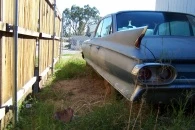
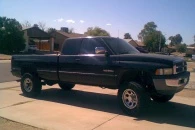
Anyways the other purpose of this blog is to share with you my successes and frustrations with delving into the obscure world of classic car restoration/modification/building. So far from what I have seen and read, there is a wide range of enthusiasts with varying degrees of philosophical precepts or rules when it comes to building or rebuilding an old car. These rules dictate which cars you should "factory new" restore, which cars are OK to modify to current technology and which cars are a waste of time. When it comes down to it none of these rules matter unless you are trying to be accepted by a certain group. Which is perfectly OK if that is what makes you happy. I personally don't like crowds or following crowds. But if I wanted to race in the National Association for Stock Car Auto Racing (NASCAR), the National Hot Rod Association (NHRA), the Sports Car Club of America (SCCA), or any other organized association I would have to follow the rules they publish. Furthermore if I wanted to win concourse, best of class shows or get top dollar at an auction I would have to abide by certain rules as well. What I don't like is when these rules become dogmatic or the only right way to do something. It all depends on you and what you want. I respect every person's view and desires when it comes to cars. I may see no personal value in what they like but it isn't my car. Having said that doesn't mean I always know what I want or what to do. My problem is that I don't have a singular point of view. This means that I like certain aspects of everything. I want to watch my car being driven but I want to be driving it as well (can't have your cake and eat it too). The problem with this is that I have wasted a lot of time over the years trying to prove otherwise. This is unlikely to stop anytime soon and will probably get worse with age. I combat this by making lists and analyzing the pro's and con's to my desires. I am currently in such a fix. Before I explain this fix let me state that I have three vehicles (and am tempted to buy more almost every day). From oldest to newest I own a 1961 Cadillac deVille, a 1966 Mustang hardtop, and a 1996 Ram 2500HD 4x4. Essentially a General Motors, a Ford and a Dodge. I don't buy the best or a brand, I buy what I like and so should you (if you can afford it). So the Ram is my daily driver it needs some work but mostly cosmetic so that can wait. The Cadillac is mystery meat at this point. It appears to be all original, repainted but with original color. It has some surface rust. I have no idea if anything works or to what extent it works. This should be prove to be a great deal of fun. But also a great deal of elbow grease. So this leaves me with the Mustang as my first order of business. I bought the Mustang after giving up on my 1987 Dodge Daytona. The Daytona was fun and sporty but being plagued with defective engine and transmission cooling designs they were a nightmare to maintain. You don't see too many around these days. I gave it away finally in exchange for the towing costs to a junk yard after many failed attempts with other yards. This was 1998 the second year I lived in the Phoenix area. I drove it away for something like $3,000. It wasn't in the best shape. The paint was little faded a few dings here and there. It was a 10 foot car or in another words it looked great from ten feet away. I couldn't be happier. I got attention with that car no doubt. The color is a silver blue which is definitely a head turning color based on experience. I started to make more money and eventually bought the Ram so I could concentrate on restoring the Mustang instead of worrying about it's reliability issues. When I parked it in 2000 it wouldn't shift into third gear, the windshield leaked on top, when I put the high beams on all lights turned off (pretty scary when on hairpin switchbacks going up to Canyon Lake in the Superstition Wilderness). The brakes were way under powered for the engines torque. Steering was unbearably difficult. The interior was in desperate need of a make over. At some point the battery exploded and corroded the tray almost completely away. I had replaced the radiator, intake manifold, carburetor, and tail light wiring harness. I added an after market radio and rear speakers. Sad to say after nine years I have no idea where any of the parts I replaced are now. My next blog will get into the dilemma I am in now after yanking and disassembling the engine. |
Steps:
|