Cam Design Guide for Weber Carbs

May 14, 2009 by pikesan · 8 Comments 

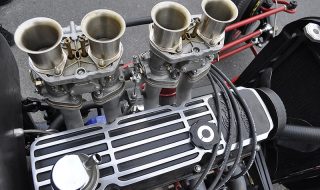
idf weber 44's with custom IR intake racingIf you’ve visited MyRideisMe.com before, you know I have a 27 Ford Roadster with a fairly hot 2.3L Ford four cylinder that’s better known as a “Pinto Motor”. I’ve got a not-so-cool problem with the Weber 44 IDF induction setup right now though…

When I get into the throttle, not that I’d ever do that, I get a misting of fuel over the top of the carbs. OK, it’s less of a mist than a toxic ozone killing cloud of gas vapor. (I’ll commute tomorrow to make up for it!). I owe you a video of this, before and after.

So what I’d do? I knew Inglese Induction Systems are the experts.  Inglese has been making intakes for this setup for a long time so they must know what’s happening and how to fix it. Even more cool? Inglese is now owned by the Comp Performance Group that also owns, Comp Cams. I’ve always had great success with Comp Cams in my Ford V8′s and my pops has been really happy too. Having 2 great reasons, I called over to Comp Cams.

“…should get the torque to come on sooner and make the car more fun to drive on the street; and in a more user friendly RPM range.”

I spoke to Jay over in Comp Cams tech support. Jay knows his cams and was super polite. I asked him to write down what he was thinking for my set up and this is what he said:

When doing cams for engines equipped with Weber carburetors, it’s imperative that you keep overlap of the cam reduced to that similar of what would be acceptable in an OEM injected throttle body type engine. The reason for this is the Weber carburetors are rather finicky as to what they like at idle and part throttle operation, and really prefer a strong/consistent vacuum signal.

When using long(er) duration cams, and/or tight (110 or less) lobe separation angles, the Weber carbs are bad about “vaporing” fuel out of the top of the velocity stacks, (as in your application). Reducing the length of duration, and using a quicker ramp profile on the cam lobes, naturally reduces overlap; as does widening the lobe separation. The combination herein provides a more consistent vacuum signal, flatter torque curve, and should (in your case) promote some low end throttle response and torque.

What I’ve come up with for you is a solid lifter cam that will be a 226 @ .050 duration on the intake; and 236 @ .050″ on the exhaust. More difference between the intake and exhaust durations (aka “split”) should help to burn some of the excess gaseous vapors that would otherwise continue to travel back up your intake manifold runners, and linger above the carbs. I’m going to suggest that we us a 112 lobe separation angle (as opposed to the 110) you have now. This, along with the change (reduction) in duration, should get the torque to come on sooner and make the car more fun to drive on the street; and in a more user friendly RPM range.

These cams also require nitriding (p/n 1-111-1) service as well.

So I asked, What’s with the Nitride treatment? It’s kinda pricey…

Nitriding over head cams is absolutely necessary. It’s strengthens the cam which has the constant load pressure associated with the follower/rocker and spring combination. The reason it’s become so necessary now (rather than long ago) is a two part answer:

Lobes have gotten far more aggressive (this doesn’t necessarily mean BIGGER); they have much faster ramp rates, more dwell time at max lift, etc. Secondly, the “big 3” haven’t manufactured anything with a flat tappet cam in nearly 20 years, and thus, the EPA has come down on the oil companies to reduce the good stuff in their oils such as zinc, sulfer, etc. (These are the things that help a flat tappet cam and lifter combination live) They are, however, hard on catalytic converters, and since the EPA doesn’t see the necessity in keeping it since none of the newer cars need it, well, it’s out. We have to find ways to combat this. The nitriding of the cam is a vital ingredient in the longevity of its life.

More to come on this story. Anyone reading this? Please leave a comment.

COMP Cams Adds “Lift” to 2009 Engine Challenge

April 28, 2009 by Hechtspeed · Leave a Comment 

Jeg's Engine Masters Challenge

COMP Cams®, RHS® & FASTTM Add $12,000 In Contingency

To The 2009 Engine Masters Challenge

EFI technology innovator FASTTM sees first visit to annual challenge while the cylinder head-valve train duo look to repeat success for the COMP Performance GroupTM

After a successful year in 2008, the COMP Performance GroupTM will once again add excitement to the JEGS Engine Masters Challenge presented by Popular Hot Rodding magazine. In 2009 CPG companies will offer up to $12,000 in contingency awards to the top six finishers of the event.

New to this year’s event will be the inclusion of fuel injected engines, giving EFI technology leader FASTTM its first chance to enter the competition as the company hopes to enjoy the same success as its fellow CPG members have in years past.

For 2009, COMP Cams® will offer contingency awards to those competitors running their camshafts, while those running RHS® cylinder heads will receive an additional payout. As the first year that EFI engines are allowed to compete, the 2009 competition will also feature contingency payouts for those equipped with FASTTM XFITM systems. In addition to contingency awards, scholarships to working students at the University of Northwestern Ohio will be donated on behalf of all contingency sponsors. Members of the COMP Performance GroupTM staff will also be on hand to provide on-site technical support for competitors.

“The addition of fuel injected engines should definitely make for an interesting event this year,” said Chris Douglas, Marketing Director of the COMP Performance GroupTM. “Last year, COMP Cams® had extraordinary results, and we look to continue that success at this year’s event with COMP Cams®, RHS® and especially our event-newcomer, FASTTM.” In the 2008 event, COMP Cams® enjoyed much success as 9 of the top 10 finishers and 27 of 30 competitors were equipped with COMP Cams® valve train products, including EMC champion Jon Kaase.

The 2009 Engine Masters Challenge is open to any displacement over 280 cubic inches, with an open bore and stroke and maximum compression ratio of 11.5:1. Rules state that these engines must be available to the public, normally aspirated, gasoline-powered, flat tappet, domestic V8 passenger car engines. EFI and data logging will be legal for 2009, as well as multiple carburetor inductions. The competition begins on Monday, October 5th and goes through Friday, October 9th at the University of Northwestern Ohio in Lima, OH.

For more information on the JEGS Engine Masters Challenge and rules, go to
www.popularhotrodding.com/enginemasters. For more information about the COMP Performance GroupTM companies and their products, visit us online at www.compperformancegroup.com.