King Richard’s Drag Race days…
December 18, 2008 by pikesan · Leave a Comment
Story Submitted by John C. Hill or MoparMagic
Virtually everyone who has an interest in automobiles knows who Richard Petty is. “The King” is considered the very best NASCAR driver fomr the early era, about the early 60s through the late 70s. Richard went on to win hundreds of NASCAR races, and multiple NASCAR Championships until his retirement from active driving in the early 90s. But, did you know for a very brief period in the mid-60′s, King Richard was a drag racer?
It’s true, and not only was he a drag racer, but Petty Enterprises created and built one of the earliest “F/X” cars, which could arguably be considered the first Hemi powered funny car. It’s also quite possible that without this particular car, the Chrysler 426 Hemi as we know it may have been eliminated from production in early 1965, never to be produced again! If this doesn’t peak your interest, nothing will! So read on about “43 jr” and find out how a Plymouth Barracuda with Richard Petty at the wheel, saved the 426 Hemi from extinction.
On February 23, 1964 the Chrysler 426 Hemi made its first appearance at the Daytona 500. The engine was light years ahead of the rest in terms of technological advancement, and the Mopars finished 1st, 2nd, and 3rd with Richard Petty winning the race. By this time, Chevrolet had already opted out of NASCAR racing. Ford on the other hand was upset that the overhead cam 427 engine was rejected by Bill France since absolutely no street cars with this engine were sold.
After the Daytona race, Ford lobbied France heavily to outlaw the Hemi as well. Since Bill France was “NASCAR” and it was essentially a monopoly, what he ruled was law. Perhaps his motivation was to even out the field and get Chevy back into racing. Whatever the motive, NASCAR decided to outlaw the 426 Hemi on October 19, 1964. By that time, Richard had accumulated enough points behind the wheel of his Hemi powered Plymouth to win his first NASCAR Championship. Petty Enterprises of Randleman, North Carolina had been in the Plymouth camp for several years. Plymouth had decided to stick with the Pettys and go up against Bill France. They told NASCAR that they didn’t need them and decided to make a very public move into drag racing!
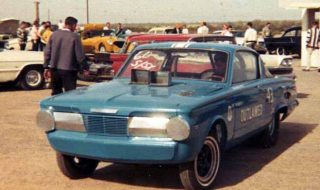
On October 6, 1964, the Pettys had a Plymouth Barracuda in their build shop. The car had a slight engine setback, a fabricated firewall and a large fabricated trans tunnel. As can be imagined, shoehorning a huge 426 Hemi with a big 727 Torqueflite into the little A-body Barracuda was an engineering challenge! The car used an 8 3/4 rear end rather than the small and weaker 7 1/4 that came in the Barracuda. To lighten up the car, the Pettys installed fiberglass fenders, hood and trunk lid. They cut away all of the inner front fenders, and strengthened it with added steel tubing above the stock frame. This tubing ran from the front wheel area back along the underbody to over the rear wheels. The seat was fiberglass set back because Richard Petty was rather tall. Finally, a large “loop type” roll bar with one single brace running back to the rear floor was added for safety. The car must have been ridiculously light, in my estimation, probably about 2,500 or 2,600 pounds. The safety features were probably OK for the mid-60s but a car like this would never pass an NHRA inspection today.
The car was finished and on the tracks by November of 1964. A sign on the front of the car read, “NASCAR, If you can’t outrun ‘em, outlaw ‘em.” On the doors, the Pettys painted “Outlawed” and “43 jr” was painted on the rear quarter panels. I have seen old movie footage of some of the earliest passes at Piedmont Dragstrip in North Carolina. This track is a story in itself! It used to be a section of highway, but when a new road was built, the highway became a dragstrip. Oddly enough, the “lanes” were barely a car width wide, and there was a big grass median strip running down the center of the entire “track”!
On November 22, 1964 Richard “match raced” against Ronnie Sox who at that time was driving a 1965 Comet with a big block Ford engine in F/X form. Ronnie beat Richard on several passes, probably due to his greater drag racing experience at the time. A rematch was held at Piedmont on December 13, 1964 and this time Richard was able to post some wins against Ronnie. By January 4, 1965 Ronnie Sox had switched to a now severely altered wheelbase Plymouth sporting a Hemi. Richard match raced him with “43jr” once again splitting round wins with Ronnie.
The experience gained match racing Ronnie Sox in 1964 gave the Pettys the confidence to hit the national level scene. “Outlawed 43 jr” was hauled across country to the AHRA drag race at Bee Line in Arizona for the January 29 – 31, 1965 race. A special class was created for home-built one of a kind cars called “Super/Stock Experimental” or S/SX. Richard’s Barracuda ran a 10.38 to win the class against a 427 Chevy II. At the same race, Ronnie Sox was running a 10.78 with his altered wheelbase B-body Plymouth, so Richard’s Barracuda was actually quicker at the time. Meanwhile, attendance was dropping off sharply for the all Ford NASCAR events. Bill France was forced to concede, and the Chrysler 426 Hemi engine was reinstated to NASCAR competition in late 1965.
But back in early 1965, “43 jr” was being booked at drag strips across the nation doing “exhibition” class racing where most of the exposure and money could be found. Unfortunately, all was not perfect with “43 jr”. A match race against Arnie Beswick at Southeastern Dragway in Dallas, Georgia on February 28, 1965 ended in tragedy. A piece of the front suspension on “43 jr” malfunctioned causing the car to go out of control into the crowd of spectators. Several of the spectators were injured, including an 8 year old boy that was killed.
The car was totaled and put in the junk pile behind the garage at Petty Enterprises. The Petty family was understandably upset, but undeterred, they build another Barracuda to continue drag racing. This particular Barracuda was a step up from the old “43 jr”. The word “Outlawed” was removed and a large white “43 jr” was the only graphics on the side doors. The Hemi carbs eventually gave way to Hilborne fuel injector stacks, and the Barracuda really picked up in performance. This car had a slightly altered wheelbase.
Petty ran the car at the NHRA Spring Nationals June 6, 1965. But, by June of 1965 Bill France had begun working on rules to allow the big 426 Hemi back into NASCAR racing. The Pettys and Chrysler/Plymouth had won the war of nerves! The 426 Hemi was soon to be in full production for six more years, and used in NASCAR sanctioned racing for several more years after that. Richard soon gave up drag racing the stout little “43 jr” and the Pettys began preparing for the 1966 NASCAR season with a Hemi Powered Plymouth.
The moral of the story is what would have happened if the “43 jr” Barracuda F/X drag race car had never been built? The 426 Hemi had been engineered to race in NASCAR competition. If the Hemi could not be used in NASCAR would Chrysler have continued to develop and build it, probably not. But, since NASCAR required engines to be build and produced in publicly sold vehicles, the “Street Hemi” was produced, and the rest is history!
In addition, the little F/X Barracuda probably opened the doors (and eyes) for many drag racers. Light weight cars, with big Hemi motors were unbelievably fast and quick. Soon after “43 jr” an entire class of A/FX cars were born, soon to be morphed into the NHRA class known as “Funny Car”. And to this day, virtually every Top Fuel and Funny Car team run an aftermarket aluminum version if the fabled 426 Hemi, thanks in part to the Petty’s and the little S/XS car known as “43 jr”.
Final Thoughts: I have been so inspired by “43 jr” and the Barracuda A/FX cars of Sox and Martin that I went out and bought a 1965 Barracuda myself. I’ve been a drag racer since 1983 and continue to race today at Firebird Raceway in Phoenix, Arizona. I run a Super Comp Mopar powered dragster and a 1970 440 Powered Cuda in brackets. I plan on building the 1965 Barracuda into a bracket car for my wife to drive. Plans are to either paint it to be a tribute to “43 jr” (more than likely) or just like the Sox and Martin Barracuda. I’ll post pictures on this site to keep you informed of my progress.
John C. Hill
Please join MyRideisMe.com and get your own Custom Garage Space (that one’s mine!) to put pictures of your car, project or whatever you’re driving!
Woodward Ave’s Legend, Jimmy Addison
November 2, 2008 by pikesan · 15 Comments
Written By: Bill Stinson, published with permission.
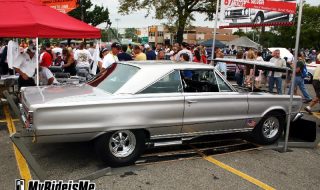
Bill wrote this story in May of 2006, but it wasn’t until 2007 when I first saw the Silver 1967 (not 68) Plymouth GTX known as the Silver Bullet. The undisputed “King of Woodward Ave” drew a crowd for days at the legengary Woodward Avenue cruise and stirred up quite a controversy when there were two of them! (that’s another story about the Silver Bullet)
Please enjoy this story from a man who was there and knew the owner of the Silver Bullet, Jimmy Addison.
The Passing of a Legend
I first met Jimmy Addison around 1961. The McKay family lived down the street from me, and of the five kids in that family, there were the twins, Gloria and Gerri (Geraldine). They were (and are) about four years older than me. One of them (Gloria) had a suitor who drove a cool ’60 Chevy convertible, black with a white top, red and white interior, packin’ a hopped-up 348 4-speed.
That car was named “Restless”. Jimmy and his friend Ted White raced the car on the street and at the strip and it was very fast for its time, especially with Jimmy behind the wheel. Race driving requires a combination of skill, knowledge, instinct, and a healthy dose of courage, and Jimmy Addison excelled in each of those categories. He was an excellent and meticulous mechanic with amazing driving reflexes, and was quite at home in the driver’s seat at well over 130 miles per hour, on the strip or on the street.
He was born on August 19, 1940, the only child of Archie and Ruth Addison. Born with chronic and life-threatening asthma, Jim was of slight build and frail as a child. But that never held him back. If he wanted to make something happen, he dedicated himself to that task until it was completed; a trait that served him well all through his life.
Now, from the mid-‘50s through the mid-‘60s, the north Woodward suburbs were hotbeds for young rodders with something being built or hopped-up in at least one garage on every block, and, with no shortage of young talented mechanics in Birmingham, Jimmy found himself right in the midst of it all.
One such ‘talented mechanic’ back then was Ted Spehar. Barely old enough to drive, Ted and friend De Nichols rented a garage to work on their cars. The garage was just across Woodward from Jimmy’s house, so it wasn’t long before the like-minded young rodders hooked up and began a lifelong friendship that took them through many ventures and adventures that ultimately led them to unimagined heights in the realms of drag racing and engine building.
In the early ‘60s, Jimmy worked at a local Cadillac dealership and then went to Jerome Oldsmobile in Pontiac, where he bought and built up a ’64 Olds Starfire. It ran a very robust 394-inch motor in a very classy ride. It was also at around this time that Jimmy bought my ’55 Chevy and he and his friend Ted White began converting it into a B/Gasser with 10% engine set-back and all – that is, until a disagreement sent them in separate directions, with White taking his freshly built 327 and going home, leaving Jimmy with a half finished gasser and no motor. The car was sold.
Jimmy first went to work for Ted Spehar in 1965. Ted owned an old Texaco station on Maple a couple blocks west of Adams in Birmingham. Besides accumulating a brisk neighborhood business, Ted had become acquainted with Dick Branstner. I used to see the ’64 Color Me Gone Dodge sitting out in front of the station, along with a little red Dodge pickup with a full-race Hemi protruding through the bed just behind the cab. My first glance at the yet unlettered, carbureted Little Red Wagon, then driven by Jay Howell. It was at this time that Jimmy and Ted began their long affiliation with the Chrysler race program.
In late 1967, Spehar bought a Gulf station on 14 Mile Road just east of Woodward in Birmingham and (I believe) it was at this time, or shortly thereafter, that Jimmy assumed ownership of the now-famous Sunoco station. It was also at about this time that he bought a nasty-looking ’62 Dodge from the Mancini’s.
It was half dark blue and half red primer, and it shook and shuddered and clattered like crazy while in Neutral, but that was nothin’ compared to what it was like in first gear with Addison behind the wheel. I remember, once while we were sitting at a light out on Woodward, I asked Jim, “How the hell do you ever get a race in this thing?” Was it a Hemi? Nope. It was what Ted Spehar described as a “thrashing machine” Stage III 426 Max Wedge in full drag race trim with a manual-shift Torqueflite with a stout set of gears out back!
That car was simply a blast. Talk about an attention-getter! And Jimmy had no problem runnin’ it hard an’ puttin’ it up wet. In comparison with the Bullet, I’d say the Dodge was the vehicular equivalent of the slavering, snarling, unwashed, fairly deranged older brother who lived in the attic. The car was a raging radical handful. It was as though Jimmy was the only one the beast would respond to. Once he was on board, it was safe for you to enter, too. Frankly, I thought the Dodge was a lot more fun than the extremely smooth-running, very streetable and much, much faster critter that was to come next. No one could have predicted the legendary status that Jimmy and his biggest project would achieve.
In the late ‘60s the Sunoco had become a nightly hangout for what was to become Chrysler’s “Direct Connection” gang. An assortment of Chrysler engineers that included Dick Maxwell and Tom Hoover, the man affectionately known as the “Father of the Hemi.” They were there to test speed parts on the street, plain and simple.
Well, one of the cars that were used as rolling test labs was a blue 440-4-barrel powered ’67 Plymouth GTX that was used for drag testing. The car had never been titled. It was snatched right off the back lot, used and abused, and eventually given to Jimmy Addison. The 440 came out, in went a lightened Hemi K-member, followed by a heavily massaged 1968 426 Hemi, the manual-shift tranny, and a Dana 60 rear end with a set of 4.56’s and a pinion snubber for traction.
In initial drag tests in ’69 at Motor City Dragway (rented by Terry Cook, then editor of Car Craft Magazine) Jimmy ran a low e.t. of the meet thru-the mufflers 11.89 at 121 mph and an uncapped 11.34 at 127. Not too shabby, eh? Well, you ain’t seen nothin’ yet!
As the weeks went by, Jimmy began making the new car into the quintessential street runner of the day. To make it lighter he took several hundred pounds of weight off the body by using fiberglass body parts and drilling huge holes in anything he could. He then modified the rear wheel wells by slitting them and forcing them outward, in order to fit a wider slick in back. And he worked evenings removing metal (with a hand grinder) from the interior of the Hemi block so the half-inch CSC stroker crank would spin freely, and a set of A990 aluminum heads and a Racer Brown roller cam were added for good measure.
The trick exhaust system was fabricated from three-and-a-half-inch pipe with two runners coming off each header and running through four reworked Cadillac mufflers. The body was then finished and prepped and the car was painted silver.
One day while Terry Cook was at the station, Jimmy took the car out for a little run off the 14 Mile light. As Cook watched Jimmy launch, with virtually no tire smoke, he mentioned that it looked like a silver bullet being fired from a gun. The name stuck, and the legendary team of Jimmy Addison and his Silver Bullet was born.
In January of 1970, I came home on leave from the Navy just before I was to be discharged. I met up with Jim and his then wife Gloria, told them I was looking for a job, and Gloria made Jim hire me. For the next few months, I pumped gas and did oil changes while Jimmy handled the mechanic work.
Now, for those of you who may have come by the station back then, to check out the Bullet or other cars being worked on there, you were probably summarily ordered off the property in a far less than gentle way. Jimmy had a business to run with a lot of time, money and sweat invested there, and he wasn’t about to waste time with kids who came to ogle the race machines. He was not a warm and fuzzy guy when someone seemed to be interfering with him providing for his family.
To Jim, family was everything. And providing the best he could for them was his main goal in life. He once told me that the primary reason he street raced was to supplement the family income. The gruff exterior was a survival tool. But there came a day when I found out what the real Jim Addison was like.
One day a guy brought in his tricked out Dart for an oil change. I did the job, but apparently didn’t tighten the oil drain plug tight and, as the guy drove off, oil began leaking out of the motor at a fairly rapid rate. Thankfully he caught it and came back to the station before he did any internal damage to the motor, and he was pissed!
He began rippin’ on Jimmy and I knew I was as good as dead. When the guy left, with a fresh oil change done by Jimmy, he took me into his office, sat me down…and calmly explained what had happened, what could have happened, and how I had to be extra careful from now on…and he gave me a raise in pay. That was the real Jim Addison. It’s a shame that few people ever knew him like I did.
Well, soon the escapades of Jimmy and the Bullet began being written about in virtually every rodding magazine across the country (and eventually, many different countries) and Jim’s reputation grew and grew, and stories about the undefeated street racer spread far and wide. There was even supposed to be a race set up between Jimmy and Big Willie Robinson, head of the L.A. Street Racers.
Willie drove a Hemi-powered Dodge Daytona. The race was to be somewhere in the Mid-West, half way between here and California, and was being organized by Terry Cook. But nothing ever came of it. Years later, when Jimmy told me the story, he said he’d have won the race anyway because Willie’s car was set up all wrong, the car weighed too much, and the Hemi was an original 426 and fairly mild compared to the Bullet.
Finally, after having done everything he could to the now infamous Silver Bullet, Jimmy sold the car in ’73 or ’74 and began work on the Silver Bullet II, which would have been a Hemi-powered Plymouth Duster. Work was begun on the drive train while the body was being acid dipped, but the car came back with too much damage due to the extreme weakness of the ultra-thin metal, and the project was scrapped.
By the mid-‘70s, with the Arab oil embargo in full swing, the Sunoco station saw less and less performance work and Jimmy sold the station in ’77 or ’78 and he stopped building cars. He continued to work at different gas stations as the Big Three got out of the performance business and, as his asthma worsened, he began to look for a less strenuous line of work. One where he could keep his oxygen bottle close at hand. Eventually, in 1993, he began driving a cab for a living, and found he thoroughly enjoyed the slower pace. He was sitting in his cab in his own driveway when the disease that nearly killed him as a child, tightened it’s grip on him for the last time. He was 65 years old.
Jimmy Addison worked hard all his life and he was fortunate enough to earn a living for most of his life doing what he did best: making engines run better, and often much faster than they had previously done. He was honest and forthright in every way, modest about his successes (which were many), and absolutely devoted to his children, Dawn and Michael, and to his beloved Donna, his wife of eighteen years.
It’s said that people come and go in and out of our lives for a reason. Jimmy Addison gave me a chance that I will always be grateful for. I’ve always been proud of him and I’ve always bragged about his accomplishments, even though he used to get mad at for doing so. And I will be forever proud and honored to have called him friend.
Bill Stinson
If you like the story, let us know. Please leave a comment.
16 Years old on Woodward Ave Circa 1968
September 14, 2008 by pikesan · 4 Comments
This story is written by Paul Schram. I met Paul after he left a comment at one of my first (and most read) blogs at MyRideisMe.com: The Real “Silver Bullet” – 2007 Woodward Cruise. The comment said:
“True, not true, fact, fiction, legend, Only Jimmy and maybe I know.
I have heard many stories…”
Being a curious (and somewhat desperate) blog writer, I contacted Paul. After all, talk is cheap. Needless to say, it wasn’t just talk! Paul was there. He knew the people and was a big part of the scene. I’m fortunate that this is the first of maybe 4 posts Paul will contribute about his time and his memories from Woodward Ave. back in the late 60′s. Here’s his first post, a bit of an introduction:
Imagine being 16 years old, in love with cars and anything to do with Drag racing. Imagine living just a couple miles away from Woodward Avenue in the suburbs of Detroit. Imagine that it is 1968, the explosion of muscle cars from the Big 3 are hitting the streets of Detroit. On top of all that imagine you work at the Sunoco gas station on Woodward Avenue just north of 14 mile Road in Birmingham, Michigan pumping 260 gasoline into almost every muscle car and hot rod that was cruising Woodward on a Friday or Saturday night. Oh, did I mention that the Sunoco station was owned and operated by Jimmy Addison the builder and owner of a certain 1967 Plymouth GTX fondly known as “The Silver Bullet”.
Sounds like a job some kid would dream up after reading the latest Hot Rod magazine. It might be except the kid was real, the job was real and that kid was me. Of course being 16 years old and totally engrossed in everything around at that time I had no idea I was right in the middle of what would become not only a part of automotive history but also street racing legend.
How do I come to write about this now? Last year was my first Woodward Cruise and like a lot of people I saw the two cars that were supposed to be Jimmy’s Silver Bullet GTX. However, one person had the car, another had the engine. It had been years since I’d seen the Bullet. And, I just recently heard of the death of Jimmy Addison. All this made me want to remember and talk about those times now that I have some perspective about what I was actually in the middle of back then.
So, who am I and how did I get that dream job for 16 year old car nut. I actually had a pretty close connection to Chrysler racing myself. My father, Brian Schram, was the manager of Chrysler Performance Parts back then. Actually he started the Performance Parts Department in the very early 1960s and ran it until 1988 when it was still known as Direct Connection and he retired. He found me my first job in cars back then. But oddly enough it was not Jimmy’s Sunoco station on Woodward. My first job was working at a Gulf station 2 blocks east of Woodward on 14 Mile Road. But this is where you see the rare opportunity I had back then. The Gulf gas station was owned by Ted Spehar. If you don’t know who Ted Spehar is maybe you have heard of another car called the “Motown Missile”. Though the Missile had yet to be thought of or built back then there were other cars that were quite famous being built and raced by Ted. The car Ted was building then was the “Iron Butterfly”, a 1964 Super Stock Hemi Dodge driven by Wally Booth at the time I worked there. But school was starting soon and though I was working full time for Ted that Summer I could not work full time during high school. So I may have been involved the first trade in racing history. I was traded to Jimmy Addison where I could continue to learn about engines and cars and be able to work evenings and weekends. And, someone who was not in school any more and working for Jimmy was sent to Ted’s new shop in Royal Oak to work full time. Sound’s pretty wild when I write about it now!
But let’s get back to the Sunoco station. What did I do back then working for Jimmy Addison? Basically I was the “grunt”. I pumped gas, I cleaned the bathrooms, I cleaned Jimmy’s tools and washed the service bay floors. However, those things did not take up all of time, so in between the cleaning and pumping I was taught about engines, cars and racing.
Here’s a link to some info about the Motown Missile and the Iron Butterfly: ProStockHemi.com;
I’ll kindly BEG Paul to go on. Please encourage him by adding any info you might have and if you’ve got some vintage pics of the “Iron Butterfly” or the “Mowtown Missile”, please let me know.