New Kookie Car Clone Wins With Stromberg 97 Carburetors
October 27, 2009 by Hechtspeed · Leave a Comment
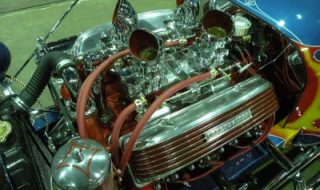
Stromberg Headquarters—Kookie car clone wins the ultimate accolade and more running genuine Stromberg 97 carburetors at the 2009 Detroit Autorama.
Stromberg is pleased to announce our involvement with the new “Kookie” car clone, owned by Detroit’s Ron Kregoski and built by Reno Rods and Customs in Oklahoma City. Featured in hundreds of magazines and a highlight of the 1950s television series 77 Sunset Strip, driven by Edd “Kookie” Byrnes, the original Kookie car is one of the best known hot rods of all time, originally built in the 1950s by actor, artist and hot rod legend Norm Grabowski.
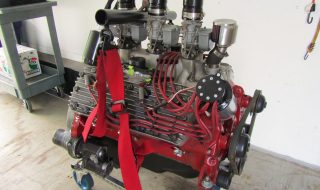
Running a hopped-up 1952 Cadillac engine with four chromed Stromberg 97 carburetors, Ron’s clone is as accurate as possible to the 50-plus year-old hot rod. He contacted Stromberg back in 2008 because their new and improved 97s are faithful in every detail to the original 97s Grabowski bolted to the Caddy’s rare Horne four-carb intake manifold.
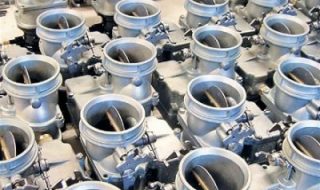
The Genuine Stromberg 97 bowl and airhorn castings, stainless steel linkage and miscellaneous screws and fittings were all shipped to Advanced Plating in Nashville, TN, for chrome plating or polishing, then shipped back to Stromberg for final assembly onto new bases, specially color matched to the red engine block. The perfectly chromed 97s are an exact copy of the original set-up, and the crowning touch to Kregoski’s clone.
Looking like it just pulled up from its April, 1957 Car Craft magazine cover shoot, Grabowski said, “It’s the closest clone done yet,” at the 2009 Detroit Autorama in March, where it garnered 2nd place in the Modified T-Bucket category. Owner Kregoski said, “For Stromberg, Reno Rods and everyone else involved in the build, Norm’s approval is the ultimate accolade.”
Congratulations to Ron Kregoski and Reno Rods and Customs.
Stromberg will make fully chromed 97s available on a special order basis. Contact our dealers for further information or visit our website at http://www.stromberg-97.com/for complete information about carburetors and the full range of service parts for original Stromberg 40, 48, 81 and 97 carburetors, as well as a complete list of Genuine Stromberg dealers worldwide.
For more information please contact Thom at (949) 496-3300 or email at hotrodthom@cox.net
Email: sales@stromberg-97.com
URL: http://www.stromberg-97.com/
Press: hotrodthom@cox.net
6 Things You May Not Know About Stromberg 97 Carbs
September 7, 2009 by Hechtspeed · Leave a Comment
Seems that the MyRideisMe.com Bonneville experience never runs out of steam. Hanging out at the Nugget one evening, we bumped into Clive from Stromberg Carburetors. After a lengthy BS session, the conversation turned to carb tech. And to cut a long story short, we asked him to contribute to our ongoing “5 Things” series. Alright, so 5 turned out to be 6 – or as the English say, ‘half a dozen’. Here’s what he had to say:
1. Stromberg Carbs Run Better With The Chokes Left In
We’ve all seen those pics at Bonneville with 97 chokes removed and the kicker linkages brazed onto the base casting. It should make sense. No choke means more air space means more cfm. And you’d be quite correct, too.
Extensive 97 flow tests carried out this year by acknowledged race carb expert Norm Schenck showed that the carb did indeed pick up a little cfm without the choke plate installed. So all those Bonneville racers were right, after all? Well, yes and no. Salt Racers are only interested in WOT. On the street it’s a different matter.
Stromberg authority Jere Jobe told that 97s run better with the chokes in, so we suspected what Norm’s tests would show. Only we forgot to tell him the full story. Here’s what he said:
“I retested the signal curve with the choke butterfly and shaft removed, with somewhat disappointing results. The signal was unstable at most of the test CFM’s, and taking the average signal at each CFM to figure the signal curve showed a much less manageable curve than with the choke parts installed. My conclusion is that the choke butterfly serves as an airflow straightening “vane” that directs the airflow to the area of the boosters with reduced turbulence. Even though the choke parts cause a reduction in flow, it is not a good trade to lose good fuel metering for that CFM gain.”
So there you have it. The same story from two very qualified horse’s mouths.
By the way, if you want to keep your choke plates fixed open, try our Choke Lock Detent kit (Stromberg Part 9537K-L), which replaces the usual round-tipped detent pin in the airhorn to lock the choke plate open.
Retails at $6.95
2. Bigger Stromberg Power Valves Have Smaller Numbers
Stromberg main jets are easy. What you see is what you get. Stock Genuine 97s come with 45s which means 0.045inch. Power by-pass valves (PV) – the ones underneath the accelerator pump — use the old engineering Number and Letter Drill system, devised as a way to fill in the gaps between the 1/64th sizes. And to complicate matters, the bigger the number, the smaller the drill!
And to complicate things even further, changing your PV by one number does not always mean the same change in jet size! We offer everything from #72 up to #60 (note that I said ‘up to’). The #72 is 0.025inch, #71 is 0.026, but #70 is 0.028 (a two thou’ jump), then #69 is 0.292 (WTF!) . The gap between #66 (0.033) and #65 is also 0.002inch before it returns to 1 thou’ per size right up to #57. We didn’t make the rules! But it pays to remember this when you’re trying to rejet.
And while we’re on the subject, remember that the PV only starts to affect the fuel ratio at just after 50% throttle. And when you swap them, cut a slot in the centre of a wide blade screwdriver so you don’t crush the centre pin and spring.
3. Set The Stromberg Float Dry
The float in a Stromberg 97 (and 48, 81, etc.) is supposed to be set so the fuel level (not the float itself) is 15/32 inch (plus or minus 1/32) below the top edge of the casting without a gasket. But to be honest, that’s easier said than done, especially with the engine running and a cigarette on the go.
So for increased customer safety, our Premium Service Kits (9590K-97 and 9590k-81) now recommend that the float is set ‘dry’, as we do at the factory. Rather than a float gauge, our kits now include an extra leaflet about setting the float level. To download a copy, click here. Basically, just get the float so it sits level in the bowl when the inlet valve is shut.
All new Genuine 97 floats are pre-set at the factory, but if you’re rebuilding, you adjust the front ‘tang’ of the hinge to push it nearer or further from the inlet valve. If (and only if !) the carb is empty of gas, hold the bowl section upside down so it closes the valve by its own weight, then eyeball it through.
4. Most Carburetor Problems Are Actually Ignition
I didn’t write this one. I’ll just leave it to the words of our dealer and very knowledgeable Stromberg guy, Bob Baxter at Baxter Ford Parts in Kansas.
“I bet 75% of the carburetor problems people call about end up being ignition. If you ever get people asking about hard starting problems once the engine is warm, ask them if they’re running 12V. Then ask if they have a wire running direct from the starter solenoid to the coil. Most don’t. Also, suppression wire with 6V is a no no. And if an original 6V coil has been replaced with a modern 6V coil, the ignition resistor might need to be bypassed.”
5. Progressive Linkage Is What You Make It
Having just launched our new Superlink multi-carb throttle arm (9091K), we’re developing our own progressive 3×3 Stromberg linkage system next, and as usual asking all the same questions hot rodders were asking back in the 1940’s. Here are a few things to consider.
First off, with a typical Stromberg progressive, if you want all three carbs to hit WOT at the same time, you’ll find that the primary hits about 50% max before it starts to open the secondaries. Stromberg throttles rotate about 80 degrees so aim for 40 degrees each side of vertical for the best geometry.

Next: Offenhauser and Edelbrock intakes have different carb centres, so the same progressive linkage will open the secondaries at different points on different manifolds. And also depending on whether the primary pulls the front carb or pulls the rear one. Ideally, in a light car, you want to run your flathead on the freeway on the centre carb only, so tyre size and gearing all play a part.
Next: Unless you’re running a monster flathead, you probably don’t need all three carbs to hit WOT. So you can actually set it up so the secondaries come in later, but never hit WOT. Bob Baxter has even set flatheads up with a dummy in the centre and a direct linkage front to back. Or with the outers as primaries and a centre secondary.
6. Stromberg CFM Flow Rates Were Quoted In The 4-Barrel Measure
This is an argument we’ve had over and over again. Back in the day, max flow (cfm) rates were measured at 3 inches of Mercury (inHg) for two barrel carbs and 1.5inHg for 4bbl carbs. And there is a conversion factor between them – ie. a 600cfm 4-bbl Holley is not the same as 600cfm worth of 2-bbl carbs.
So when people read the old published flow rates: 150cfm for a 97, 175cfm for a 48 and 130cfm for the 81, it’s assumed that these are at the 3inHg, 2bbl measure. But that assumption is wrong. For some reason, those figures are actually 1.5inHg, 4-bbl type figures. Which is incidentally why, four 97s work great on a 350 Chevy (work it out).
Finally, our own flow test results put the new Genuine 97 at 162cfm. A Speedway carb made 154cfm. And (to avoid any bias) the Barry Grant 98 made 162cfm too. All measured at 1.5inHg.
Look for more how-to’s and tech info from Stromberg Carburetors in future articles at MyRideisMe.com