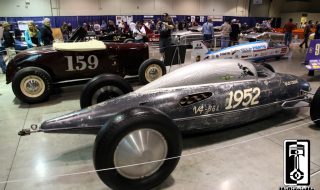
Save The Salt Foundation Gets $40,000 from "Century of Speed" For those of us who have been honored to walk on the surface of what is known as The Bonneville Salt Flats, there is a myriad of terms used to describe the experience. Common words like magic or mystical or speed heaven are almost immediately used and usually accompany a kind of far-off gaze that comes over the face of the person relating their experience. It’s as if this specific part of the planet was put aside just for speed addicts. For 100 years we speed addicts have pushed, pulled, carried or driven our mechanical mounts out to one of the strangest places on earth, where little survives and even less is welcome. Here on The Salt we’ve sought the ultimate prize of speed, shooting first for that magic 100 mile per hour plateau but today taking all sorts of racing machinery to 200, 300, 400…heck, let’s just go for 500 or 700 miles per hour. At Bonneville, though the limitations can place great obstacles in front of the speed demons that shoot across the shiny...
Bonneville SAAB Story or . . . How I Raced Three Cylinders and Broke Land Speed...
posted by Jim Volgarino
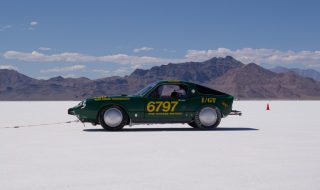
Rare 1968 Saab Sonett II makes up the base of this land speed record holder The temperature is about 100 degrees, there’s no wind and what shade there is comes from an overhead tarp stretched from the side of a trailer. But Tom and Patti Donney are busy moving around their race car, methodically checking it over and getting ready for another trip to the starting line last August during Speed Week 2013. Getting the couple to break away and actually sit down to talk about their passion for speed seems, well…awkward. You learn right away that Tom and Patti aren’t just talk. They DO. With no reservation. The little ’68 Saab Sonett II sits at center stage of this passion that began just three short years ago and has culminated each of those three years during fabled Speed Week which happens each August on the Bonneville Salt Flats, a desolate, but perfectly flat expanse of salt outside Wendover, Utah. A full cage and chassis was built to fit the Saab plastic body. (Phone camera photo) The head is off the Sonett’s three cylinder...
Stunning City of Burbank Streamliner at Bonneville after 7 Year Build
posted by pikesan
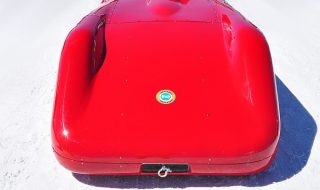
Beautiful, Historic and Fast Flathead Streamliner All I did was capture the return to Bonneville. Dave Thomas, owner of this beautiful recreation of a circa 1952 land speed record holding streamliner. The sleek fiberglass beauty has been known by a few names, but finished here, it's the "City of Burbank" #61 XF/GS streamliner. Dave summed up Bonneville here... "August 18, 2013..... The dust er salt has settled. We made it to Bonneville. We got thru tech inspection and had a chance to make a run down the course. It was the most exciting thing I have done in long time. Our driver pulled away from the push truck and motored off into the distance. We chased him for 5 miles before we saw the tiny speck up ahead parked in the turn off area. We didn't go all that fast but the car ran the whole 5 miles without incident, right out of the box. It had never turned a wheel under power before that. The little 276 inch flathead did all it could considering the density altitude was 6700 feet. No excuses, we were...

Racing RV Rocks at 2013 Bonneville Speed Week
posted by pikesan
How about a 120 mph Custom RV? You won't be complaining about being caught behind this rig! Words and Pictures by Jim Vogarino Sitting on the huge expanse of pure white salt, the evil looking all black motorhome looks even bigger than it is. Everything is black…windows, trim, head and tail light covers. It couldn't be more sinister. Britt Palmer pulls himself out of the custom racing cockpit, ducking under a complex structure of roll cage. He’s a good sized guy, 6-2, maybe 6-3 and he gives a solid hand shake. You’d never know he is suffering from a debilitating disease that eventually will rob him of all movement. Right now he’s too excited. "We’re headed home,” he says, slipping off his race togs and giving high fives to people who have gathered around the vehicle in his pit area during Speed Week 2013. “We came to just run for speed and I think we did pretty well." Bonneville Speed Week is pretty well known for odd vehicles and the 1977 GMC Kingsley motorhome easily fits that category if only because of its size. Sitting at the...
Salt Water Fish Racing at 2013 Bonneville Speed Week
posted by pikesan
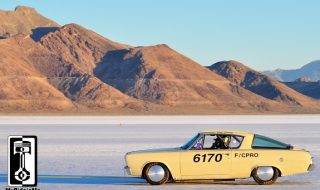
World's Saltiest 1966 Barracuda! Normally when you see a car in impound, the crew attends the race car's mechanical needs, if any, then starts cleaning and removing the salt from the last run. Don'tcha wanna look your best? (going to impound's a good thing! Look here for Setting a Record at Bonneville) These are a couple cool-lighted morning shots of Robert (Bob) Dally's 1966 Barracuda on the way back to the starting line to backup their record run on Sunday morning. Bob landed in impound since they went 113 mph on a soft 100 mph F/CPRO record. On Monday, the record was set at 115 mph, then again on Tuesday at their top speed of Speed Week 2013: 132.85 mph. F-size engines are only up to 183 cu. in, so Bob's Barracuda wasn't running a Hemi, it was a little old slant 6. Salty Grille! Bob and his crew didn't spend much time cleaning, so it was an opportune time for me to grab some shots! As you could have guessed, some people complained about wet conditions out on the track and the 'Cuda certainly shows that. ...
Chute-Poppin Photos from 2013 Bonneville Speed Week
posted by pikesan
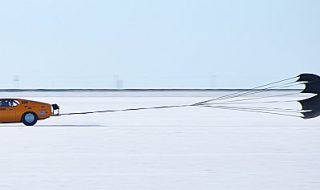
Somebody get me a longer camera lens! I'm not a professional photographer.... I don't have a super long lens... like this guy: I could sit around and whine about what's fair, but instead, I decided to experiment!! I've been going to Bonneville since 2009, so I've seen alot of the great white expanse. I haven't, however, spent too much time near the end of the track. The Bonneville race cars speed by at 200 to sometimes 400 mph, so you don't have much chance for photos! I tried my Nikon 18-200 anyway and here's what happened... Chute pops! This #507 owned by Dan Aleshire running in the B/GR (roadster) class. We were standing near the 5 mile marker (as you can see in the photo below). The "long course" at Bonneville was 5 full miles of race track. You can set a record in any mile, or you can slow down and exit the track anywhere as well. Only cars running 175 mph or higher are allowed on the long course and the faster cars will use every bit of the 9 mile run-off to slow down....
Bombshell Buick’s Back with Another Record!
posted by pikesan
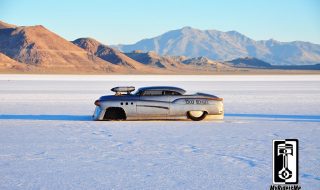
Brock's Buick Upgraded & Faster at Bonneville Kicking off Bonneville 2013 Coverage, here's a quick look at the upgrades on Jeff Brock's too-cool 1952 Buick Super Riviera. We profiled the birth of "Bombshell Betty" in another story about this Bonneville Record Setting Race car here. In the the picture above, you can see the windows added to the side of the car. Also, you get a first look at the custom made intake scoop! Jeff's an artist and no slouch when it comes to metal work! If anyone wants the above picture for a screen saver, shoot me an email, I'll be happy to send it over! Success! Jeff broke his own record. Rocket Heads Studio running in the XO/GCC class ran 165.735 on a 165.380 mph record. Yes, by 0.355 mph! Make sure to check out more pictures of "Bombshell Betty" with the rest of the build history here: Birth of Bombshell Betty for Bonneville Click here for all of MyRideisMe.com's Bonneville Salt Flat...
El Mirage 200 mph Club for the Nice Guys
posted by pikesan
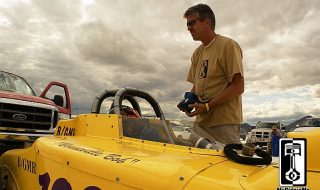
My First Land Speed Racing Friends Get Their Record If you've never heard about the kindness of folks involved in land speed racing, at Bonneville Salt Flats or at El Mirage, let me reiterate. You're bound to meet some of the greatest people on the planet. I met "Bonnieville Bob" and his son Rocky on my first trip to Bonneville in 2009. Bob's been racing long enough to, literally, know everyone out on the salt. Like you'd expect, Bob and Rocky introduced me to everyone and now, years later, I owe most of my friendships on the salt to these guys. Well, after years of trying, Bob and Rocky have their 200 mph hats from El Mirage with sites locked on Bonneville in August for Speed Week. Rocky text me the good news and sent these pictures: Then, in Rocky's words.... We got there on Friday and went through tech without any problems. Saturday morning, my dad made a run and the car ran 220.576 mph! He didn't even know he ran that fast since he couldn't see the gauges and drove by the...
1959 Jaguar Sedan reaches 200 at the Ohio Mile
posted by JCourter
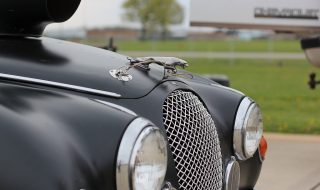
Land Speed Racing at the Ohio Mile Kris Henderson build this car with the help of friends in the 80s and has been tinkering with it and racing it ever since. In it's current configuration, it's running a custom built 572" BBC with nitrous. During the Ohio Mile, Kris was trying out some new tires that were taller and skinnier. The decrease in traction was more than he was anticipating - making for a few wild passes down the 1 mile course. This video is a compilation from several views in and around the car. It is concluded with Kris going over how and why the car was built into the monster that it is today....
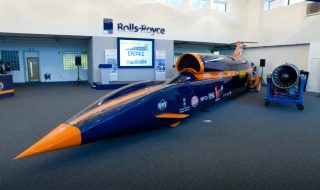
Bloodhound SSC Update – Lands Rolls Royce as Supporter
posted by pikesan
Land Speed Racing: Quest for 1000 mph #2 We can't get enough of Bloodhound SSC. A quest for 1000 mph? Awesome, even to think about it. So.. when the Bloodhound gang releases a press release, I share it. Here's a few more tasty bits of info your mind to chew on... The world land speed record of 763 mph is held by Thrust SSC, a UK team lead by BLOODHOUND’s Project Director Richard Noble and driven by Andy Green. Components for BLOODHOUND SSC are being manufactured by specialists across the UK and delivered to the BLOODHOUND Technical Centre in Bristol for assembly throughout 2013. UK runway testing (up to 200 mph) will get underway early 2014 before the team decamp to the Hakskeen Pan, South Africa to begin high speed testing. The BLOODHOUND team scoured the globe to find the perfect desert to run the car on, it needed to be at least 12 miles long, two miles wide and perfectly flat. The Hakskeen Pan, Northern Cape, South Africa was selected. At full speed BLOODHOUND SSC will cover a mile in 3.6 seconds, that’s 4.5 football pitches laid...
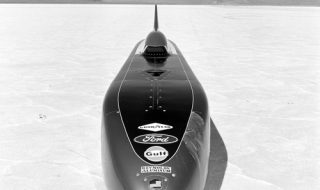
Mickey Thompson’s Challenger – Finishing a Father Son Project
posted by pikesan
Challenger 2.5 Rebuilt by Danny Thompson for Bonneville Land Speed Racing I 'm honored to hear Danny Thompson's story of how he'll rebuild the race car his father, legendary racer Mickey Thompson, originally built in 1968 with help from Ford. I believe, and I've said it before, land speed racing folks are extraordinarily kind people. Count Danny Thompson as one of those people and as a brave and dedicated man. After losing his father roughly 25 years ago, Danny now knows: "... It's still a father son project, nothing's changed... he's just not going to be there in physical being." Please enjoy this interview with Danny Thompson with historic pictures from the build website thompsonlsr.com. Additional images courtesy of Holly Martin Photography. [youtube]http://youtu.be/xG5n4kFNlsA[/youtube] What a great story of perseverance. Thanks for sharing it Danny! Please show your support for Danny and the team by checking out their online Challenger 2.5 store, or please leave a comment if the story's got you thinking about projects you worked on with your pops. I know I am. Click here for all of MyRideisMe.com's Bonneville Salt Flat...
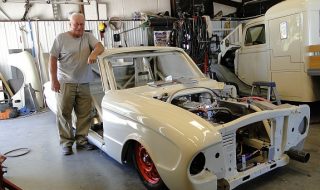
280Z-Powered Falcon Ranchero Bonneville Speed Week Results
posted by pikesan
280Z powered Falcon Ranchero Race Results Remember this car? Just looking at it's low, built-for-racing stance, it was easily one of my favorites from Bonneville - and that's before I saw under the hood. With a Nissan 280Z inline six suppying the power, I had to ask the owner to keep me posted on his first year racing results from 2012 Bonneville Speed Week. If you need to see so more pictures, check out this 1960 Falcon Ranchero here. Here's what Alan Morris out of Montrose, CO had to say about the first time out with his Ranchero: "I apologize for not replying sooner. I've been busy cleaning the car, removing the engine and assessing the engine damage. Plus I needed a rest. I have thrown most of my energy at the car for about two and a half years. At 70 years old I don't seem to have that much energy anyway. The first run (the maiden one for the car and me as well) they only want you to run to the two mile mark and pull the parachute. They don't want you to...