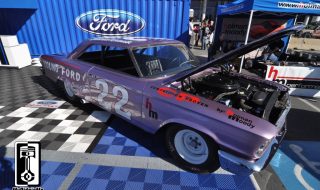
Classic Movie Clip Redline 7000 – How NASCAR Should be!
Now this is what NASCAR should be! Imagine going 179 mph in these cars! (that’s what the movie “track announcer” said) Those brakes and all that weight running that fast!
This clip is from the 1965 film called “Redline 7000” There’s a pretty well done crash stunt for the time. FIRE FIRE!!
Yes, that is Mr. Sulu!
Here’s part #2 (not sure how related it is to the first part…)
Then for something totally unusual, but still somehow related to this post… I give you, “Speed Lovers”
Holman & Moody Boss 429 – (you should read this)
July 14, 2008 by pikesan · 3 Comments
The first step in fixing a problem is admitting you have one. Hi, I’m Craig, I don’t know crap about bodywork. (Hi Craig). With that out of the way, I moved onto the next step. That’s seeking help. I turned to my new friends over at Squeeg’s Kustoms in Mesa, Arizona. Squeeg’s has been turning out show quality paint and bodywork since 1964 and Doug Jerger, the owner and Squeeg’s son, has kept the business rolling. One of Doug’s latest paint jobs was for his America’s Most Beautiful Roadster (AMBR) contenting 32 Roadster. I was in good hands for my shotgun lesson in body work to support the 63 Falcon Wagon project.
When hot rods and custom car building’s in your head nearly every waking minute, hanging out in a shop like Squeeg’s might as well be Disneyland.
When I pulled up, Doug and the Jerry Courlton were standing out front marveling at the fresh custom paint on Jerry’s Corvette super gas race car body. Wow. ![]()
It’s tough to put down this many colors without having that, “I’m stuck in the 80’s” look, but Doug nailed the graphics and stripes, as he said, “Right out of my head.” Then, as if it weren’t one-of-a-kind enough, Doug laid a custom purple to burgundy paint pattern or “paint effect” down the center of the car, including the pro-stock style scoop. “You’d shit if you saw how I did that,” he said, “painters use all kinds of tricks to make effects.” Needless to say, the Jeffy was thrilled and if the rest of the car is half this nice, he’ll have one of the baddest race cars at the track.
There was more! No need for a park hopper pass to find the nearly finished 40 Ford Coupe in full hot rod trim in the next room. Owned by Bill Cromling and sporting custom mixed blue paint and classic orange-yellow flame job with a 500HP/500 Ft-lbs Roush 402IR fuelie motor. This car’s gonna be a real modern-day hot rod. I should have shot more pictures of this car to show the detail you get from a professional build shop. Even parts of the car that will be hidden by upholstery or other panels are neatly detailed to the point it’s almost a shame to cover them! I’ll have to hook up with Bill later to shoot the finished car (Before it’s featured in several magazines…)
Later in the day a trailer pulls up driven by Eric Peratt from Pinkee’s Rod Shop in Windsor, Colorado. Doug’s so busy doing paint and body, he farms out some work to other shops. For this Daryl Wolfswinkel owned super custom 32 Roadster he’s building, Pinkee’s fabbed the rolling frame, suspension and powertrain setup, then the cars on the way to Marcel’s Custom Metal Shaping in Corona, California for a hand made body. The frames as beautifully made as it is stout. The beauty’s most obvious in the motor mounts. Check these out!
That’s why I love shooting a car as its being built. These details, the kind car builders really get into are going to be hidden once the car’s put together. Those mounts hold a beast. With all the custom touches, what else would you expect then a NOS, aluminum headed, Holman and Moody NASCAR Boss 429. This engine has all the Ford tricks available in 1968 and was built for the new “aerodynamic” Torino Talladega. Those tricks include: revised oil system, o-ringed block, special hemi head design, and much more (could be an entire blog!)
(More info: LINK, another LINK), Topped by an experimental dual 4 barrel low-rise manifold (maybe-like 1 of 3 made), this motor’s an E Ticket ride waiting to happen (not recommended if you have a heart condition or are expecting).
Last but not least, the one-off wheels are, believe it or not, almost as cool as the engine. Made by Mike Curtis (the machinist you know from Boyd’s TV show and Overhaulin’) conceived and rendered by Jimmy Smith and then designed by Mike with a Halibrand-like twist. Doug put on the finishing 5 extra ribs and requested real knock-offs. These wheels are the perfect combination of high tech and hot rod. I’d leave them just as they are, with the ball mill tool marks, but they’ll be polished. Too cool. (more on these wheels and Mike’s new line of wheels soon)
This won’t be my last visit to Squeeg’s. They’re so busy though, I’ll have to come back at least every other week to catch the latest builds. But, I’ve got a lot more to learn about bodywork, so I’ve got the perfect excuse!

Welding to Win with Joe Gibbs Racing
October 8, 2007 by pikesan · Leave a Comment
Welding to Win with Joe Gibbs Racing®
Courtesy of Lincoln Electric
Hidden along a tree-lined parkway of unmarked office buildings in suburban Charlotte, North Carolina, lies a brand new steel-and-glass white structure that could be home to any number of corporations in any industry.
But through the main door it becomes clear that this is something more than an insurance agency or software firm. It’s home to Joe Gibbs Racing®, bejeweled in trophies, racing jackets and display cases literally filled with artifacts from the nation’s fastest growing sport.
Past the receptionist, across the main lobby, an observation deck overlooks one of the most advanced auto shops in the world. Through a panel of high windows is a conspicuous absence of grease stained floors and stray tools. Instead, the vast open space of more than 150,000 square feet shines in pristine white and better resembles an operating room than a fabrication shop.
It’s a virtual racecar laboratory, where engineers work side-by-side with master fabricators to create the fastest machines possible within the guidelines established by their sport. Those team fabricators, in turn, rely on the welding experts at Lincoln Electric® for welding equipment, access to emerging welding technologies and training for recommended techniques using the most exotic base materials.
“Most people don’t realize that we build a separate car for each race,” explained Mike Logan, a fabricator for Gibbs Racing. “We’ll have 12 to 14 cars ready each season, and more if there are bad wrecks.”
Along the main wall behind Logan sit half a dozen No.20 orange Home Depot® NASCAR® Nextel® Cup cars, all in various stages of completion. Each one is meticulously hand built for 2005 NASCAR® Nextel® Cup winner Tony Stewart to race throughout the 2006 season to defend his 2005 Championship title.
Some 200-plus craftsmen at Joe Gibbs Racing® work 40 to 50 hours a week year-round building cars for Gibbs’ three Nextel® cup drivers. Each car is designed and fabricated to the unique requirements of its intended track, race configuration, speed and driver.
But long before the rubber hits the road, fabrication consumes roughly 950 man-hours on each car, not including the 500-horsepower engines brought in from outside. About 95% of NASCAR® racecars are TIG-welded by hand.

Hundreds of individual parts are cut, welded and machined by hand, from the chassis and frame to suspension and drive train. The bodies are painstakingly shaped to reduce wind drag. They are tested in multi-million dollar wind tunnels and then reshaped again.Most top shops demand that the quality and technology of each component meets the high standards established by the aerospace industry. About half the parts are carbon steel and many are aluminum in a wide range of thicknesses and joint configurations. Some rare parts are titanium, where NASCAR rules permit.
TIG welding is the preferred arc welding process for aluminum in NASCAR® and Lincoln® Precision TIG® welders are the preferred tools for the job at Joe Gibbs Racing®. Joe Gibbs Racing exclusively uses TIG and MIG welders from The Lincoln Electric Company. In turn, Lincoln is recognized as an exclusive NASCAR Performance® partner.
Many TIG welds in NASCAR® are performed out-of-position. Distortion is always an issue, especially with aluminum. However, using Lincoln’s pulse systems controls heat input in the weld to minimize that distortion, many top NASCAR welders say. In some instances, fit tolerances must fall within 1/1000ths of an inch, and distorted aluminum contours cannot be tolerated, said Shane Love, chief fabricator for Joe Gibbs Racing, who oversees production of Stewart’s cars.
“Lincoln’s pulsing mode is great for this,” he said. “Nothing else on the market can touch it. I wouldn’t work with anything else.”
The tolerances and standards are imperative both for performance and weight, Love added. While NASCAR imposes weight restrictions for cars, the trick for fabricators is welding the strongest joints possible without unnecessarily increasing weight.
“Every ounce matters,” said Dennis Klingman, a welding teacher to NASCAR fabricators with Lincoln Electric and chairman of the National Education Committee with the American Welding Society. “At almost 200 miles per hour, these cars are pushed to their very limits. They have to be strong for safety, but they need to be light for performance. They’re right on the edge. Every weld has to be perfect.”
The cars built for Stewart are no exception. Defending the title, he and his team of fabricators know that even a single imperfection could mean a race – or worse, his life. Most welds are inspected visually, X-rayed or tested with magnetic particle inspections.
“Quality welding is the main issue with these cars, and there is very little margin of error,” Love said. “They need to look good and perform even better.”
Nearly all welds on Stewart’s cars are made with The Lincoln Electric® Precision TIG® 375 – a machine designed for welding specialty alloys and aluminum in a variety of TIG process applications. It’s a favorite tool for many in the aerospace industry, as well, for the same reasons.
The Precision TIG features Lincoln’s MicroStart™ Technology for a smoother, more controlled arc and better starting arc performance. With MicroStart, welders can more easily establish a stable arc at low amperage levels, even down to two amps.
“The start is really nice,” Love said. “And that’s very important for the overall quality of these welds. I also love the AC Auto Balance® to give me the right amount of cleaning vs. penetration, used together with the pulsing mode, for maximum control on aluminum.”
The Precision TIG 375 provides full function capability for setting pulse frequency, background amperage and percent peak versus background time. The easy to understand control panel, along with the AC Auto-Balance and Micro-Start technologies that do their work without intervention, make fabrication simple for the wide range of welding work in this shop. Local Lincoln technical engineers backed by a technical team back at headquarters also lend their expertise to optimize machine settings for the toughest applications.
“The guys at Lincoln are constantly looking for a better way to do things,” Love said. “And for our purposes, they are on the cutting edge of this stuff. They do a great job of working with us here in the shop to make us better welders.”
View/Print/Download PDF version of this story Want to see results like this? We can help. Ask Lincoln How!