Filler Detective – Best New Car Bodywork Tools at SEMA 2010
November 14, 2010 by pikesan · 3 Comments
Best New Tools from SEMA 2010
I’m no body man, and I’m not sure I want to be. It’s hard work, takes a long time to learn and it’s probably done wrong as much as it’s done right.
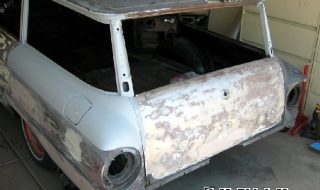
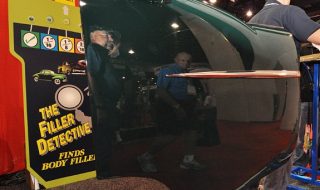
I do know something about inspecting bodywork in preparation for paint or checking a painted car to see if it’s straight. Straight has different meanings though. To some professional body men and to car owners who’ll only be happy with the best, it means “like a mirror”. I looked at the door shown above for a while cause I knew it had dents in it. These dents had been filled by body filler, probably a ton of it… otherwise, there wouldn’t be much to show for The Filler Detective!
To review, “Body Filler” is the generic term for products such as: Bondo (a 3M product), Putty or spot putty, Feather-Rite or Duraglass from USChemical or Evercoat. Whatever you call it, filler is part of the bodywork process and in very general terms, the less of it you use, the better the bodyman or bodywork. Without going into too much detail on that, thick body filler hides damage that wasn’t repaired correctly. The trouble is, body filler that’s too thick can lead to a host of problems you don’t want… cracking and trapped air or air pockets that show up later as pinholes are the worst of it.
If you’re buying a used car, especially a used hot rod or classic car, the last thing you want is for fresh paint or primer to be hiding ten gallons of body filler. You can count on whatever’s hiding coming out later and costing you a bunch of money, sometimes more than the car’s worth in the first place.
That’s where The Filler Detective comes in… As I learned, “As the lights go up, the price goes down.”
On the same door, we used the Filler Detective starting in the top corner. The handheld tool is easy to use. Press the felt covered end onto the painted surface and slide it while pushing the button. It’s alot like using a stud finder. As shown, if there’s no body filler or it’s less than 1/16″ thick, you’ll get a green light like here. (trust me, it’s green)
Uh-oh! What’s this!? Look closely and just under the door handle, we found hidden body filler! Check back to the first picture. See the reflection of the guy walking by? See any distortions or waves there? Neither did I, but there’s 1/8″ of bondo or filler hiding. This might be OK, but let’s keep looking.
Maybe this is a car you shouldn’t buy. Despite the shinny and flat-looking appearance, there’s 1/4″ or more of body filler on this panel. What’s that hiding? A big dent? Rust? Both? Instead of pulling the dent or banging it out with a hammer and dolly, the painter simply covered it with alot of body filler. Not cool.
So in this case,the painter’s extra time block sanding could have fooled me into thinking the bodywork on this ride was alot better than it actually is. Or you could say, I shouldn’t trust my eyes alone.
As I watched demos at The Filler Detective’s SEMA booth, bunches of people, painters included, tried and failed to spot the hidden dents. I also heard alot of the same questions came up:
- Is this the same as a paint thickness meter?
- NO! This isn’t measuring the thickness of the paint, it’s measuring the filler.
- It’s alot cheaper than a paint thickness meter too (over $600 vs. less than $100)
- Will it work on Aluminum panels?
- No. The Filler Detective uses a magnetic field to detect body filler, therefore, ferrous metals only.
- What kind of body fillers does it work on?
- Bondo ® 3M™ Bondo Filler®
- 3M™ A Acryl–Green Spot Putty
- Feather-Rite ® USChemical®
- Duraglas®USChemical®
- Evercoat®Quantum1®
- U-Pol Flyweight Gold
- Aluminized Evercoat® Metal-2-Metal™
- Aluminized ALL-METAL®FILLER by US CHEMICAL®
- How do I know it’s working? and accurate?
- The Filler Detective comes with everything you need, including a battery and a gauge for checking accuracy.
- On one side is metal, on the other is 1/8″ of plastic. Any time you’re wondering, use the gauge to check. The yellow light comes on every time.
I had to try it myself, so I used a panel that wasn’t painted:
As I swiped the soft felt-covered end over this door, I was happy to see the accuracy of The Filler Detective. Alot of top quality paint jobs have some filler. Filler’s not your enemy, it just needs to be applied correctly. On the outside edge of the filler where it’s “feathered” with the metal and very thin, the Filler Detective didn’t make a sound and the light stayed green. Piece of cake.
Not bad right? SEMA agreed and awarded the “Best New Tools and Equipment Product” award for SEMA 2010.
Any other unanswered questions might be answered by the video below. Other than that, leave a comment and we’ll tried to get you the info.
Falcon Build Update #3- The Roof
June 30, 2008 by pikesan · 3 Comments
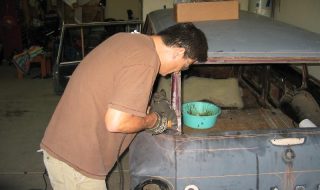
I think it was Earl Sheib who said, “Body work is glamorous!” He was lying! Ok, I made that up. Body work’s dirty and you have to use a bunch of tools that make noise. I like that part! But, it takes so much time. It’s hard work. This week, I enlisted another friend, Joe Nagy. He came over to hit the roof of the wagon, and that we did. (for a good laugh, check out the Earl Scheib home page and the endorsement from Danny Boneduce)
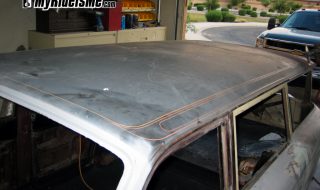
On the left, you can see where we started. For some reason, I really like wagons, but I guess that was before I wanted to paint one! The roofs, as they’re known, are LONG. I’m pretty lucky that the roof’s straight and basically trouble free except for more of that black primer filled with that strange oil the previous owner used to keep it sorta-shiny. (I already said, please don’t do that…)
Joe and I fired up the wire wheel and DA sander only to find that sucked. From there I decided to go back to the paint stripper to ease the pain some. Does anyone know of a stripper that actually works? I’m sure it doesn’t help that it’s 90+ in the garage, but still, as much as I put on, you’d think some more of this ratty primer would come off. Not so. Even the “Aircraft” quality stripper I had wasn’t that hard core. I want the paint to peel off in one big sheet! But, I also want my kids to have clean air and clean water. I bet in the old days, paint stripper got it done! Here’s what the paint stripper did. Any paint that does peel off is still paint I don’t have to force off.
After throwing almost every wire from my low-buck Harbor Freight wire wheel, this is what was left. The original color of the car was burgundy and a cool one at that. Once I hit color, bare metal or the grey/yellow primer, I moved on to the next spot. I wasn’t trying to get all bare metal, just get all that oil off there. Looking back, I think it would have been worth it to have the entire car blasted. I would have done that, but I didn’t want to find any major surprises. Small ones, ok, but from what I’ve seen on Overhauln’, some stones should be left unturned. Speaking of Overhaulin’, check out this “Overhaulin’ game”. You can customize a car. I think Chip probably threw up a little bit when he saw it.
![]()
After the wire wheel, I broke out the DA sander with 80 grit paper. It’s amazing how much better that works when it’s not trying to gum up with the old black paint. It didn’t take long at all, then I was ready for some primer. You can see in the picture above there was only 1 spot with any filler. The DA smoothed that out nicely so I can put a little more on.
3 cans of primer later, the roof finally looked like we had done something! The solid gray after looking at the spotted mess of paint, steel and primer was a great change. I used a long board for the first time to do the first bit of sanding. Or maybe I should say, I tried using it. Wanted: Dude who can teach me how to use one of those without undoing all work from the previous step. I did get some advice tonight, but I’ll have to wait to give it a try. You can see that one spot with filler. I learned how much hardener is too much tonight too. That stuff kicked so fast I threw half of it away. Time to wrap it up for the night/week.
Just to catch you up completely, I also got most of the passenger doors stripped and ready for the DA and primer treatment. Then, here’s a picture of where the rear door handles have been filled in. That area’s smoothing out nicely to get ready for Squeeg’s filling primer. I learned from Doug why his primer’s the best and I’ll blog it all soon.
Much more later, we’re just getting started. Stay tuned. Any comments on the progress?
Thanks to my current sponsors:
- Heat and sound insulation from Auto Insulation
- A great new steering wheel, a stock one from Cesar at Vintique Inc.
- Doug Jerger and Squeeg’s Kustoms for the Epoxy Primer Filler
More sponsor opportunities available!
Falcon Strip Party Update – What not to do…
June 23, 2008 by pikesan · 11 Comments
In case you missed the last story, I’m rebuilding my 1963 Falcon Wagon. Originally, I just planned to put some paint on it and re-do the interior, but after inviting a bunch of friends over (here’s the story), my wagon’s now a stripped hulk sitting in my garage. Borderline panicking but not quitting, I’ve still got great friends helping out. We’re making progress. It’d be easier to get out to the garage if it wasn’t 112 today!
The first thing I should mention is the “How-to” I wrote in my garage. In addition to adding pics of your ride, you can also use your garage to help others by showing how you did something… like a tech page. I filled in the backup lights in the tailgate of my wagon and wrote a “How-to” about it. If you ever need to patch a small hole, it might be an interesting read. Click HERE to see it.
First off, I have to mention the tireless help I’ve been getting from my friend Ken Ford. (perfect name for the project, right?) Ken’s a body guy and was looking for a reason to get dirty on a project. He’s got a Harley at home now has built several VW’s in the past, including a few vans, so he knows how to get body panels looking good.
It’s a good thing too! We’ve been moving around the car looking for disasters. We really only found 1. The previous owner decided to fill the cowl vent. I guess it looks a little smoother, but I’d leave it. (too late now!) I wouldn’t mind putting it back either cause it might be easier when you see the mess he left. We knew there was a problem there because the bondo had cracked. When we got to work cleaning it out, this is what we found. It’s hard to see from this picture, but there was about 1/2 inch of bondo covering this patch panel. He didn’t finish-weld the patch, so I think some moisture got underneath it and cause the cracking. This is gonna require some minor surgery to repair. I think it might actually be easier to find a new cowl and put it in. What do you think?
While Ken’s been hitting the outside, I’m inside cleaning the floorpan. It looked pretty nasty at first, especially in the pics. Really, it’s not that bad. Everything all rusty colored, but there was only one small spot of cancer rust. I’ll write about how I handle that in another blog. Here’s the before, during and finished pics of the floorpan. I’m going to use POR-15 to seal the floor up, then insulate the hell out of it with the insulation from Auto Insulation. I removed about 20lbs of muck and filth from the car. Ever wonder where that “old car” smell comes from? I can tell you! I’ve also included a pic of the rear floor. I hit this thing HARD with a wire wheel and it still looks pretty nasty. I’ll cover it with carpet anyway, so it’ll get more POR-15.
So here’s the progress on the rest of the car. We had to strip off all of the old black primer. The previous owner used some kind of oil or something, (I thought it was Armor Al) to keep the primer looking somewhat shiny. Whatever you do, don’t do that. Ken was using up DA sanding paper like crazy with that crap loading up. The cars all spotty, but when Ken throws down some primer, it looks good. I hit the front fenders with some paint stripper and then with a wire wheel to get all the black off. It’ll look worse before it starts to look better.
I also included a shot of the first of many paint supplies I’ll need. The guys at ARS, Finishmaster hooked me up a little and are going to try and help get PPG to sponsor the build. Brandon at ARS didn’t mind waiting a bit since I came right from work, even on a Friday evening. Its nice to work with good people. Rather then buy this and that from a swap or an auto parts chain, I’m buying all quality supplies. With all the work we’re putting in, I want this to be nice.
Brandon also started helping with colors. That’s gonna be a tough choice. I know it’ll be blue cause that’s what my kids want. I know the car was originally Heritage Burgundy. It’s a cool color, but it ain’t blue. A friend said that Ford offered a light blue similar to what I’m looking for in 1963. Brandon said to look at www.AutoColorLibrary.com to find the color. Glacier Blue or Peacock Blue might be cool.
That’s it for now! Thanks to my current sponsors:
- Heat and sound insulation from Auto Insulation
- A great new steering wheel, a stock one from Cesar at Vintique Inc.
- Doug Jerger and Squeeg’s Kustoms for the Epoxy Primer Filler