Waves at Pebble Beach Concours – Hot Rod Art
August 17, 2011 by pikesan · 2 Comments
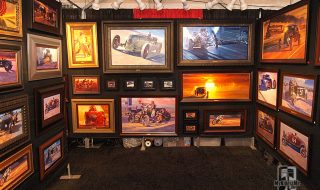
Hot Rod Art by Tom Fritz at Pebble Beach Concours d’Elegance

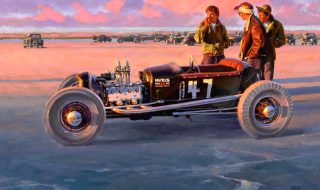
(Click picture for full size) “What D’Ya Reckon She’ll Do?” – Oil on canvas, 41″ x 27″
Catch Hot Rod Artist and overall cool-guy at the upcoming Pebble Beach car show. Tom Fritz art has been featured several times here at MyRideisMe.com for a simple reason: Tom’s paintings inspire! Tom captures the coolest hot rods and vintage motorcycles in vivid colors, but what you’ll remember is the emotion seen in every painting. You’ll wonder, what’s that guy thinking?
It’s my pleasure to see Tom all over SoCal and at Barrett Jackson in Arizona, and it will be yours too at Pebble Beach Concours d’Elegance. The show runs from August 17-21 with the Automotive Fine Arts Society (AFAS) Exhibition on Sunday, August 21.
Here’s Tom prepping you for the show and his new paintings:
Two globs of oil are scooped up and shmushed onto the sheet of glass I use as a palette. A couple quick swirls and the color is pretty close to what I’m looking for. A little modification with a previously mixed color satisfies my eyeball, so I scoop it up with the brush, turn back to the canvas, and…
I look at the painting. Nothing. I look again, expanding the cone of my vision. Still nothing. I hold up my hand-mirror and look at the image in the mirror. The loaded brush is still sitting in my grip, locked, loaded, but just idling…

Another look.
That moment is here. The moment when another stroke is unnecessary; anything else I do to the painting won’t add a thing. It’s finished. The painting is finished. It’s not done… cakes are ‘done’ — paintings are finished, and that moment has arrived. Sign it, varnish it, frame it, throw it in the truck and get it up to Pebble Beach for the annual show.
What no-one ever sees is the jig I do when I discover I’ve just completed the last of the three “never-before-displayed” paintings required for the Automotive Fine Arts Society (AFAS) show at the Pebble Beach Concours d’Elegance. I call it a jig, because that’s what it is. It’s not really a cavort. A cavort is that dance we artists do after making a sale, or after the judge considers your paintings aren’t good enough to be considered community property.
I counted them. I lined up the canvases and counted… one, two, three… four.
Huh?
Four? I counted them again. Shit. Four. I created FOUR NEW paintings.
Good thing no one was in the studio shooting video because I started busting moves like M.C. Hammer. Can you imagine if this video showed up at my sanity hearings?
Well, so there I was, all worn out, out of breath, wondering how I’d explain my footprints in the “cottage cheese” on the studio ceiling to Molly, when the thought occurred… “I gotta show these to people”. And then I thought of all my friends who wouldn’t be able to be at the show.
So here y’all go. Here are the four paintings. One of them will be reserved as my choice for the judging for the Peter Helck Award (Best of Show as determined by the artists themselves).
The paintings are reserved for sale at the Pebble Beach Exhibition, but prints are available of all four. Hollar at me if you just gotta have one.
-Tom Fritz
www.fritzart.com
tom@fritzart.com
__________________

“Incident At Twenty Mile” – Oil on canvas, 36″ x 18″

“Locals” – Oil on canvas, 36″ x 30″

“Out Quicker Than A Hiccup” – Oil on canvas, 48″ x 24″
If you can’t get enough of Tom’s art, check out how he creates it in this story. It’s one of the best at MyRideisMe.com. I just wish I wrote it!
Mellow Artist Paints Nostalgia and Speed
Car Art and Hot Rod Art Become Fine Art
Have you ever met Tom Fritz? Chances are, you’d remember if you had.
You probably noticed the dark display at one of your favorite car shows, then you were drawn in by the vivid paintings filling almost every bit of dark. I last ran into the flip-flop wearing, ultra soft-spoken Fritz at Barrett Jackson 2010. I don’t know crap about art, especially fine art except for what I like, and I like what Tom’s throwing down.
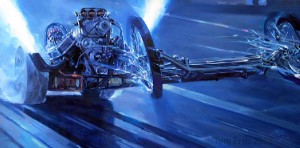
Tom’s art is all the more sweet when he takes the time to talk with you about each piece and fill you in on some of the catchy titles like: “Feeling the Belts”, “Raising Merry Hell II”, “Ancient Barbaric Amusements” and one of my favorites, “Quick Sombish”. (link to Fritzart Gallery) Tom wrote about the making of “Quick Sombish” from the concept sketches to the in-process work and of course, the finished piece (shown here). To date, it’s one of my favorite stories at MyRideisMe.com and a recommended read for any artist. Read about this Wheels up front engine dragster by clicking here.
To pass the time when Tom’s at a show, sometimes he’ll paint. Swanee nabbed this action shot of Tom at my request because I just couldn’t believe how he holds his brush. Arm extended, holding the brush nearly at it’s end, he paints these strikingly beautiful paintings. Is anyone else amazed by this? I’d shake and be smooth like a California highway. It’s a treat to watch.
You can barely see the reference photo he’s got behind the light, and even tougher to see in a photo is the sketched image he’s after. From there, Fritz usually adds a period character that no doubt loves his hot rod like no other (or is driving the piss out of it!)
These two paintings are 1 of a kind. I know the Hemi powered, blown dragster racing out of the blazing sunset was sold before the paint dried. As you can imagine, Barrett Jackson attracts quite a few who only want (and can easily afford) original paintings. Up in the top left corner of this picture, you can see another of my favorites, mentioned above, called “Feeling the Belts”. Chutes-out, this front engine dragster’s easing to stop through an almost Tom Fritz-signature, warm and glowing sunset. Damn Tom, it’s hard to pick a favorite!
So when you see Tom at the next show, go say hi and ask about, “Messin with the Institution” or maybe, “Shaving the Devil’s Beard” shown in his display. The same warm glow seen in the painting’s also waiting for you in conversation with Tom. Enjoy.
Visit Tom Fritz website here.
Over My Shoulder… Making Hot Rod Art
September 27, 2008 by pikesan · 21 Comments
Please enjoy your brief, but meaningful and entertaining, look “over the shoulder” of painter Tom Fritz as he makes what I think is my favorite piece of Hot Rod Art to date (and he’s got alot to like!).
Over My Shoulder… Making Hot Rod Art
Written By Tom Fritz
(Car and Motorcycle fine art)
One of the side benefits of working at my art is that I’ve been blessed with the development of an extended family of very close friends, a rich variety of both men and women who support me in my self-inflicted torture. And as sit here in front of yet another blank canvas trying to figure out the combination of what I am and what the world needs, I’m reminded of all the conversations in which I’ve been asked, how hard is it to make my art, or how long it takes me to make it — in which they try to get a handle on how I put a painting together.
These questions invariably come up at shows and in order to portray the illusion of credibility in a compressed time frame, I use convenient phrases like “it really isn’t so hard.” But honestly, it really IS hard work. After all, evolving an image and style can take a long time and can be, at times, a hellish nightmare.
So, I figured I’d allow you to sit and watch over my shoulder for the first time ever in a published format as I weld together a story of image, paint, color, and technique, and hopefully do so with a forceful result. I’ve never done this before, and the one thing I don’t want to do is give you all a step-by-step, here’s-how-I-mix-this-color art lesson. I’ll leave that to the television artists.
To begin, I’d been scouring events earlier this year looking for an example of a front engine dragster typical of those I remember from my youth. I REALLY want to put something together with one of those.
Remember I mentioned that my process could be painful? How painful can it be to put an image together? Well, it seems to be ingrained in the motor sports arts that every painting has to “be of someone or something” – that every painting has to contain specific history and other incidental baggage, which is something that I really don’t care to drag along. When I was young, the thing that really kicked me in the zipper about the whole wang dang doodle was simply this: metal making noise. To this day, it remains the prime visceral element that I respond to and the main thing I try to accomplish in my work. I’m presenting a time capsule that contains the same raw, core experience I remember and digested as a kid. In fact, I think this is still the thing that sucks us all through the turnstile. After all, I can’t believe we just go to the races to enhance our memories of who was driving what, when, and where so we can go hot-dogging at the bench races.
The point for me, then, is to find a middle ground between form, content and story telling that I feel comfortable with. I’m trying to put on canvas something intangible, invisible, and something that exercises my observational sensitivities and aesthetic taste. And I want to create an exciting image no one has ever seen before – an image with a point-of-view no trackside photographer could have snapped.
Can you now understand why it’s pretty easy for us artists to work from a photo taken by someone else? I understand this, because lets face it – starving can become a nuisance. But besides surface-level copyright infringement, there are even bigger issues for me.
First, I’m an artist. I need to create. I don’t want to just color an old photograph. Sure, I use the old pics for reference, whether it be historical tidbits, a “jumping off” place, or for inspiration… but not as the basis of my image. Photographs record detail. My job is to take elements from a photo, and from them make a subjective, aesthetic statement to evoke a particular emotion or mood. Besides, the old photos (which in the motor sport realm are mostly “snaps”) hold visual traps that most artists unwittingly fall into, unknowingly painting in distortions and compositional weaknesses inherent in the image.
Another thing. That lucky artist that went through the shoebox first snagged the most dramatic images, leaving the chaff to the rest of us. So, then I have to ask myself if I’d really want to paint something someone else already painted? (Sheesh, how many renderings of Bob McClurg’s 1972 photograph of Wild Willie Borsch in the “Winged Express” have we seen?) And then, I wonder why I’d want to paint all the leftover images that aren’t really all that great to begin with?
Therefore, I brutalize myself to come up with the hard stuff.
Enough talk. Time to squeeze out some worms of color, sharpen the brushes, and bring on the pain. Pull up a chair, kick back and join in the madness. Watch out… some say the oil paint fumes make them intoxicated (you’ll notice I don’t hold my breath while I paint).
One more thing. I’ve got my camera here, and understand I’ll have to “pull” myself out of the altered state of consciousness I fall into when I paint every so often to take a picture of the emerging image. Sort of like waking up from a dream state. Lessee how this goes…
Pah-rooz these reference photos I took…

What a mess, right? They’re black n’ white photos, there’s nobody straddling the rear axle, the throttle plates are closed, the tires are obese, and the header tips are covered. Also, there’s a lot of stuff in the background like park benches and trees. And this isn’t a “hero” car, for chrys-ache. Where’re the stands with all the people? Where’s the Christmas tree, the fire extinguisher, the tower? (Just about now, that “path to temptation” pointing to the shoebox of old photos is starting to look better and better…)
Back in the studio, I take a rare free moment between projects and put out a small quick-n-dirty thumbnail to see if I could translate the image I see in my mind into reality.

Usually I don’t take this step, opting to go direct-to-canvas instead. But this time I wanted to verify my intention to limit myself to a decidedly monochromatic, cool color scheme. In my sketch, the left front wheel protrudes beyond the image boundary, which compositionally stabilizes the subject, tying it into the frame. You can see that I have to work out issues of lighting, as I now have multiple light sources (two spectacular white plumes of burning hydrogen as well as ambient lighting) as opposed to the one light source I have in my reference photos (the sun). Some parts of the car in my sketch stand in front of my perceived light sources, some are beside a light source, and other parts are just filled, again, with ambient light. And to top it off, I have to translate how my eyeball experiences violent motion in buttery oil paint, without relying on convention (Dang! That shoebox of old photos just keeps looking better all the time…)
After preparing the canvas, I lay in my image, keeping my line work loose and broad, preventing me in being too much of a slave to my reference. Once I’ve done my sketch, I start applying my initial washes. I don’t do this tentatively; I really hunker down on that thing. These washes are laid in with thinned paint and a big brush, and the tones are lightly washed in transparently to cover the whiteness of the canvas.

Here in these detail photos, you can see some of my initial line drawing and washes, done both with pen and brush.


(click images above for a better look, and a snazzy Viva Zoom effect)
I work on the whole canvas at once. It’s pretty direct. Every stroke relates to the whole. I don’t start in the upper right and work to the lower left, after all, there’s a great joy in watching the painting come together all at once. Now here’s a look at the canvas on the easel, the morning after the first session. The painting is 42 inches wide by 21 inches high.

At this point, the painting is going together pretty smoothly. I constantly keep things moving around, making sure nothing calls attention to itself. However, something is up… look at the top of the right front tire in the progression images. Notice there is a ghosted tire that disappears, only to reappear later?
Either I’m overdosing on fumes, or this is clear and present evidence of rampant imagination not being tied down to a paint-by-number approach. Try something here. No, take it out. Wait, I liked that – bring it back. Just me peeling another layer of ass off myself as I paint. Oh, the agony…

Look how various other parts of the image evolve, how the shape of the exhaust plumes develop. Notice how I translate the spinning front wheels into paint. I try to create something authentic, not derivative, so I disregard cliché and try to find my own answers. The brush strokes become smaller in those areas I’d like your eye to pay attention to. I’m not much for painting every slot in every screw head. That level of detail just calls attention to itself. Rather I activate areas by placing small, colorful paint strokes that are tied to intelligible forms and resolve into suggestive detail in the viewer’s eye.

Check out how the decal arrangement on the side panel below the headers has progressed. These are merely color hits that “read” as decals and text (we call it “greeking” – you can’t read it, but you know it “says” something). I’ve brushed in a light colored circular element on that panel because my eye tells me it needs to be there. Also, you see incremental changes. “Tightening up” the front end and front wheel areas, and also around the rear tires.

Finally, the long chain of decision-making comes to an end, and here’s the result. How do I know when the painting is completed? When there’s nowhere to put the next stroke. It just subtly let’s me know it’s done. The actual brush-to-canvas on this one took about 40 hours.
What’ll I call it?
“Quick Sombish”
Lean it up against the wall, rest the eyeballs a bit, then on to the next one!
Another story about my friend, Tom Fritz: