Idaho Invades Cali for America’s Most Bitch’n Roadster
1923 Hot Rod T
At the best hot rod and custom car shows like the Grand National Roadster Show there’s always car instantly identify with and of course, cars that totally miss. For example, car-covering murals of dragons done in florescent green on a black base ain’t my thing. Lucky for me, it didn’t take long to find my car. (Click any picture for full size)
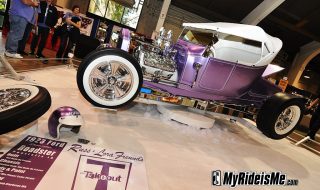
On the first day of the show, right through the side doors of the main hall where I set out for my first look at the 12 America’s Most Beautiful Roadster contenders… there sat Russ Freund’s “Takeout T”. At first I was shocked. Is that purple? Can it be? Yes. Knowing the 12 AMBR cars are the best of the best roadsters at Grand National, I knew I’d found this year’s “America’s Most Bitch’n Roadster”. When’s the last time you heard someone say a light purple car is Bitch’n?
Is there another AMBR award? No, not officially! I made it up for the sick-of-sick roadster called, “Double Trouble” back in 2009. Here’s the blown, Ardun head 32 Roadster built by Hot Rod Garage. I saw that car sell for just about what the owner paid for the chrome work at Barrett Jackson the next year, but that’s another story!
I talked with Russ at the show to find out why this car and what’s a dude from Idaho doing at California’s top hot rod show? That’s when I learned the great story of this build… it was friends helping friends and members from “The Inland Emperors” who build a car that literally cost a fraction of other AMBR contenders.
Several years ago, while working in his very first hot rod, a 1931 Phaeton, Russ got the idea to take a bunch of T parts he had and make it into a rat rod. Nothing special, just something to mess with… why not? Most of what he needed, he already had. After piecing together a rolling T, he ran into what might be a hot rodder’s most common problem: Not enough garage space. To clear room for the ’31′s new chassis, he needed a new home for the ’23.
A buddy offered to store the car, so half jokingly, Russ said, “Just give me some money and I won’t pick it up.” A deal was made and the car was outa the garage.
Three years later… the T had just sat. No work had been done, so Russ offered to buy it back as part of a three-way deal with another club member. The T came home and plans were made for a nice, driver-quality hot rod… nothing special, just a good car to sell for cash to finance another project. But after staring at the steel bodied ’23 for a little while, then placing the chrome front axle setup in front of it…happened! An AMBR was born (the b’s for bitch’n). Here’s a few pics from the build.
Selling some parts then trading others Russ wheel’d and deal’d his way to all the parts you see hear. Along the way club members, friends and locals helped where they could in exchange for cold malty beverages, favors and parts they needed to finish their own projects.
Russ Freund, a dude from Postfalls, Idaho in a 18×20′ garage built this stunning, show stopping roadster, “With a little help from my friends.” Russ is a soft-spoken guy and you could hear the sincerity when he thanked his friends and family… In Russ’ words:
My Dad Claude Freund helped the hole way through from start to finish and was all ways there pushing and supporting me even when I thought I wasn’t going to make it or when thing looked really bad he was able to find a way to get me through to see the car make it to GNRS. And, my mom Susan Freund for supporting both of us.
John Gunsaulis helped me the whole way through the project from that extra set of hand and eyes to masking the car for paint to final assembly. Darrell Peterson helped with machining different parts to fabbing the exhaust and final assembly.
John Logsdon helped with final assembly and fabbing and welding the exhaust
Jeff Allison designed the exhaust and interior, almost on the fly, and the pinstriping thing above the rear diff. Jeff also added his opinion weather I wanted it or not! He also did this cool t-shirt over at http://www.almost-cool.com/ (click to buy the shirt)
George Frank out of Clarkston, WA stitched up the upholstery from Jeff’s idea.
Dave Swenson built the 48 Ford flathead with Cyclone heads and Thickstun intake. (note how the engine and trans are ground smooth and painted white!)
Mike Robinson did the 39 Ford transmission with open conversion hooked to a quick change rear diff. Billy Payne helped polish stainless and aluminum.
Thanks guys!
Biggest thanks go to my wife Lora for putting up with me and through the build and supporting me the whole way!
After the GNRS, the Takeout T hit the show circuit… and cleaned up! But don’t call Russ’ T a Trailer queen! Russ is looking forward to driving it when the show tour’s done.
Awards as of March 2011:
- 2011 Grand National Roadster Show (debut):
- Triple Gun Award
- H.A.M.B Roadster Award
- Bob McCoy “Real McCoy” Award
- America’s Most Beautiful Roadster: Best Engine
- 2011 Sacramento Autorama Awards:
- Lee’s Vintage Award,
- Best in Class
- Outstanding Paint, Detail and Display
- Darryl Starbird’s 47th Annual Car Show, Tulsa, OK:
- Fine 9 Award
- Rod and Custom Hall of Fame Award
- Silver in the rod class
- 2011 Detriot Autorama:
- Best in class
- Outstanding detail and engine
Russ, you looking for another 3 way trade?
Well? Is it the next America’s Most Bitch’n Roadster?
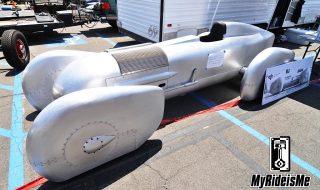
Europe’s First Dragster – The Allard Chrysler Dragster
October 28, 2010 by Hechtspeed · 3 Comments
1961 Chrysler Hemi Nitro Dragster from the UK
Story by Brian Taylor

Sydney Allard’s 1961 Allard Chrysler dragster (source Crazy Horses, National Motor Museum, Beaulieu)
Drag racing has come a long way since its beginnings in the USA during the late 1940′s. And although it had a culture of straight-line sprinting (runs against the clock rather than a knock out competition) dating back to the early 1900′s, Europe had to wait until early in 1961 before it saw its first dragster. It was born when British sports car manufacturer Sydney Allard stormed into the office, slammed a copy of a Hot Rod publication featuring Chris Karamesines’ Chizler dragster onto the table and announced, “We’re going to build one of these”.

Sydney Allard, the father of British drag racing. (source Crazy Horses, Gavin Allard collection)

The Allard Chrysler being built. Sydney Allard watches from the cockpit as designer David Hooper (left) checks the plans and John Hume (right) adjusts the steering. (source Crazy Horses, National Motor Museum, Beaulieu)
There were no official drag racing regulations in existence in Europe at the time. Royal Automobile Club building regulations for cars used for sprinting and hill-climbing had to be followed and these were pretty general to cover a range of competitive disciplines. They would severely limit the potential of Sydney’s first attempt, the new Allard Chrysler dragster having to have front brakes, covered moving parts plus front suspension.
Work on a 354 cubic inch Chrysler Hemi engine commenced in his London workshop during 1960 and speed equipment was ordered from Dean Moon in the USA. He decided on a front mounted blower rather than top mounted as on the Chizler because with covered moving parts it enabled better streamlining. And in truth, initially the car was seen as a way of putting a bit of ‘jazz’ into sprinting (which was suffering a bit of a decline at the time) rather than bringing the American sport of drag racing to the UK.
The car was first shown at Brands Hatch in the Spring of 1961. It was without its bodywork and although the car was not run on the track the blown and injected Chrysler Hemi V8 engine was fired up. Britain heard its first American styled dragster.

The Allard Chrysler at Brands Hatch in 1961. (source Crazy Horses, LAT/Autocar)

The dragster is unloaded at the 1961 Brighton Speed Trials (source Crazy Horses, National Motor Museum, Beaulieu)
Sydney held a ‘live’ press demonstration of the car on the old Club Straight at Silverstone, but the first appearance of the dragster in front of the public was at the long established Brighton Speed Trials in 1961 (the first of these events was held in 1905). During the rest of the year and through 1962 its ‘art-deco’ styled body could be seen at sprint meetings and shows throughout the UK, putting down mid 10-second standing start quarter mile times with estimated terminal speeds of around 150 mph. The fuel used was methanol with a small percentage of acetone.

The Allard Chrysler dragster at Goodwood in 1962 (source Bernard Gudge)
In July 1963 Sydney received a telephone call from a speed shop operator and drag racer in Las Vegas called Dante Van Dusen. Duce, as he preferred to be called, issued a challenge that he could beat the Allard Chrysler and Sydney accepted. Duce mentioned the project to one of his speed shop suppliers Dean Moon and Dean offered to provide his 600 bhp 350 cubic inch Chevrolet V8 engined Mooneyes gas dragster for the trip.

The then President of SEMA Ed Iskenderian stands besides the 1963 SEMA Trophy (recently re-discovered and on display at the National Motor Museum, Beaulieu. (source Crazy Horses, Gavin Allard collection)
Moon mentioned the upcoming match race at a meeting of the recently formed Speed Equipment Manufacturers Association (SEMA) and they put up a trophy for the winner – the SEMA Trophy. Mickey Thompson was at that SEMA meeting and he immediately made plans to join the party as an uninvited guest.

Sydney Allard (right) in the Allard Chrysler lines up alongside Dante Duce (left) in Mooneyes. Dean Moon does the flags. (source Crazy Horses, National Motor Museum, Beaulieu)
Allard and Duce first appeared together on the Club Straight at Silverstone on September 10th of that year. Then at the 58th Brighton Speed Trials, the second event of the Challenge, Sydney and Duce were joined by Mickey Thompson with his blown and injected V8 Ford powered nitro burner, the Harvey Aluminum Special.
The dragster demonstrations were saved until the end of the day and the 30,000 crowd was shocked into disbelief. The next event in the Challenge series was held at RAF Church Lawford, followed by RAF Debden the next day. Even though it was not promoted as a spectator event around 5000 people blagged their way past astonished RAF Debden Police and lined the strip. Allard and Duce called their Challenge Series a draw and the SEMA Trophy was left with Sydney Allard’s name on it. The spectacles fired the imagination of hundreds of budding UK hot rodders and drag racers.
Duce and Dean Moon returned to the USA very enthusiastic about the UK trip. Moon offered to be a spokesman for the idea of getting a team of American racers across the following year and within a month Sydney Allard and Wally Parks of the National Hot Rod Association were in discussions.
The 1964 International Drag Festival series of six meetings was held over three consecutive weekends in different parts of the country – Blackbushe, RAF Chelveston, RAF Woodvale, RAF Church Fenton and RAF Kemble. The American team was selected in match-race pairs of the most popular drag racing classes at that time (dragsters, gassers, factory experimentals and drag bikes) and consisted of Don Garlits, Tommy Ivo, Bob Keith, Tony Nancy, George Montgomery, Keith Pittman, Ronnie Sox & Buddy Martin, Dave Strickler & Grumpy Jenkins, Dante Duce, Doug Church, Bill Woods and Don Hyland. Sydney’s son Alan Allard took the Allard Chrysler to a best time of 10.28 seconds at 150 mph

The Allard Chrysler at the 1964 Drag Festival. (source Crazy Horses, Gavin Allard collection)
By this time it had become clear that the 1961 Allard Chrysler dragster was now well past it’s sell-by date. It had become obsolete with no chance of development to modern standards due to the RAC regulations in place when it was built. So they commenced building a new dragster, this time one designed solely for drag racing rather than a highbred for sprinting and they used the engine and front mounted blower from the original Allard Chrysler.
Sydney Allard died in 1966. The old 1961 Allard Chrysler rolling chassis had been kept at the London workshops but after Sydney died it was moved around Southern England when his companies were split up, ending up in Alan Allard’s barn for many years. Alan handed it over to Allard Owners Club member Brian Golder in 1979 who carried out a part restoration of the rolling chassis and body before loaning it to the National Motor Museum, Beaulieu. After Brian’s death it was bequeathed to the museum. There it has remained on display for many years with most visitors not really recognizing its historic importance until recently.
It was 2008 when the latest chapter of the Allard Chrysler dragster’s story was opened. During research for his book for Haynes Publishing called Crazy Horses – the history of British drag racing, author Brian Taylor became very aware of the excellent condition of the car and its importance in the sport’s history as Europe’s first dragster. He judged that it wouldn’t take too much work or funds to get it back into condition where it could be ‘cackled’ and paraded.
He contacted Lord Montagu of Beaulieu and after a series of meetings the Museum Trust gave the thumbs up, so Brian decided to form a group of enthusiasts who could start raising the funds and provide the expertise to take the project forward – hence the Allard Chrysler Action Group (ACAG).
Brian acted as Chairman of the ACAG liaising with Doug Hill, Chief Engineer and Museum Manager. Pink Floyd drummer Nick Mason agreed to be the group’s patron. He is Chairman of the National Motor Museum, Beaulieu Trustees Advisory Council and a Trustee. The first job was to thoroughly inspect the car to see what was needed and establish some kind of budget and task list. Fortunately one of the group was David Hooper who designed the car for Sydney in 1960 so his input was invaluable.

ACAG members and National Motor Museum, Beaulieu staff inspect the car. (source ACAG, Alan Currans)

ACAG Patron Nick Mason tries the car for size. (source National Motor Museum, Beaulieu)

ACAG members with Patron Nick Mason at Beaulieu. The 1963 SEMA Trophy is in front (source ACAG, Simon Maurice)
The band of supporters gradually grew and along with cash donations, the sales of items like special ACAG T-shirts, Polo shirts and limited edition prints helped swell the funds. By the end of 2009 they had raised enough money to place an order for a replacement 354 Chrysler Hemi V8.

Prints of a painting by Paul Whitehouse helped raise funds (source ACAG)
However, they don’t make 354 cubic inch Chrysler Hemi’s any more and it was obvious that the USA was the place to source the parts and the expertise. Getting American suppliers and fans on board was an important aspect of keeping costs under control – much easier to do with a direct American involvement in the project. ACAG American support was strengthened when Project 1320 Chairman Traci Hrudka agreed to be ACAG Co-Patron. Project 1320 is a Trust supported by the top names of American drag racing, formed to plot the history of drag racing in film. At the same time legendary drag racing personality Linda Vaughn became an Honorary Member of the ACAG.
After some research the ACAG chose Michigan based engine builders and nostalgia specialists Booth-Arons. A complete and accurate replication was not possible due to some parts manufacturers not being around anymore and other original details missing from the available information. Booth-Arons recommended that the new engine be built to take high nitro loads (90%) for the best ‘cackling’ performance. This would also toughen up the engine, making it less likely to fail. But aesthetically it would be exactly the same as that built back in 1960/61.
They located a 1956 354 Chrysler Hemi engine with original paint and decals on the valve covers – a truly unmolested and perfect starting point having originally been an industrial engine.

The 354 Chrysler Hemi heart of the car at Booth-Arons in Michigan before work commenced (source Sam Eidy)
This was completely disassembled and, thankfully, it was discovered that it had a standard bore and crank. The thick walls and webs on these older, untouched, blocks don’t require a torque plate. It was baked and blasted prior to honing.
The head surfaces were then decked and made parallel so that everything was equaled out and the bore honed to a perfectly round 4.060 inches diameter with a 3.625 inch stroke taking it out to 375 cubic inches. This unshrouds the valves (normal practice for race engines) and facilitates a louder more fiery sound when the engine is fired up plus more flames from the exhaust headers – providing the right cam is used of course.
Taking it out to 375 cubic inches also enables the use of Big Block Chevrolet rods, pins and journals; often easier (and cheaper) to obtain than Chrysler. Racetec Pistons designed and donated the pistons – 10 billet slugs to provide spares. The main bearings are standard Chrysler Hemi size.

Custom made Racetec pistons (source Sam Eidy)
Beaulieu had a blower, blower manifold and Potvin adapter, from a part-restoration carried out in the 1980s by Brian Golder. These were sent to Booth-Arons and the blower forwarded to Littlefield Blowers in California who re-tuned it for the front-mounted Potvin set up that characterises the car.
Meanwhile, back at Booth-Arons, the bright work was tumbled and polished – including a rare set of valve covers that were sent to the chrome shop after some metal work had been carried out by Al Bergler. Because the engine was so pristine, with little run time, the crank was simply checked that it was straight, then polished and nitrided for surface hardening. Other parts were machined and made ready for assembly. Everything was weighed and balanced on an individual component basis before the piston/crankshaft assembly was balanced.
Steve Sanchez of Total Flow Products, Michigan did all the headwork. New Manley valves, valve guides and seats were fitted. Trip Manley is Vice President of Manley Performance Products Inc, a company with a relationship with Booth Arons that goes back to Trip’s father Hank and engine builder Denny Hummel. When Trip heard about the Allard Chrysler dragster restoration he was keen to become involved.
He said, “After talking about it with Denny we decided to utilize our very best “Severe Duty” stainless steel, 3/8” diameter, Pro-Flo design intake valve blanks and our “Extreme Duty”, 3/8” diameter exhaust valve blanks…..precisely machined for this 354 Hemi application. These are the exact same exhaust blanks we utilize for all of our Top Fuel and Funny Car competitors”.
Crower donated custom-ground cams and springs. Trend Performance supplied the pushrods (and piston pins). The block and heads were registered and receiver grooves machined when the heads were returned to Booth-Arons and assembly of the short-block commenced.

Heads now on and blower manifold in position for measuring spacers. Crank had been taken out for shortening. (source Sam Eidy)
Three legends. Custom car designer George Barris, drag racing personality and Honorary ACAG member Linda Vaughn besides the blown and injected 354 Chrysler Hemi being readied for the Allard Chrysler. (Rocker covers are slaves.)
Hilborn supplied a 2-port injection system and fuel pump. Edris Snipes is Vice President Hilborn Fuel Injection and she said,
“Hilborn Fuel Injection is pleased to acknowledge the importance of the Allard Chrysler dragster in UK drag racing history and is proud to celebrate its legacy through participation in its resurrection! This restoration project will most certainly help to commemorate and perpetuate vintage drag racing heritage”.
But prior to mounting the blower it was discovered that the crank snout had to be shortened before it could be mated with the blower adapter. And there have been other problems along the way such as the length of pushrods and the need for spacers between the heads and the blower adapter (both probably the result of decking the head). Availability of parts (difficult enough with an engine of this vintage) has gradually become more of an issue as the economic recession has forced suppliers to reduce their stock holdings.
A Taylor Vertex Magneto was assembled in the USA – exactly the same as the Scintilla unit fitted to the original engine back in 1961. And at the time of going to press the engine was getting very close to final assembly ready for dyno-testing before dispatch to the UK in November.

The engine painted red. Rocker covers are not as being used. The car will have the rare plain covers as fitted to the original. (source Sam Eidy)
Stuart Bradbury of U S Automotive of Bedford has been handling the USA-UK logistics and technical liaison and they will organise the completed engine’s return to Beaulieu. Work can then start on finishing the restoration of the rolling chassis and components.
2011 marks the car’s 50th birthday and plans are being made for it to visit the USA. The Project 1320 team in the USA is working with the ACAG to achieve this with the possibility that the Mooneyes dragster will appear in the UK at the National Motor Museum, Beaulieu during the same period. At the beginning and end of the swap period there will be opportunities for these two iconic cars to appear side-by-side for the first time since 1963.
The ACAG now has its own website www.allardchrysler.org and the dragster has its own Facebook Page. The group has been very disappointed with corporate response to the project and apart from insurance company Performance Direct, so far the ACAG has raised all the funding for the restoration themselves – with the welcomed product support from American suppliers. If you would like to help fund or sponsor this unique and exciting project, or purchase ACAG merchandise, then contact brian@allardchrysler.org or visit the website.
The full story of Sydney Allard and his Allard Chrysler is included in Brian’s book Crazy Horses – The History of British Drag Racing published by Haynes. A visit to www.amazon.com or www.amazon.co.uk will give you suppliers.
1933 Tudor Street Rod Is A Cross-Country Cruiser
September 21, 2010 by Hechtspeed · 3 Comments
1933 Ford Street Rod Featured Ride
I first shared a quick photo of Jim Baugh’s light blue 1933 Ford Sedan Street Rod in the Salt Flats Speed Shop Open House story. When Jim pulled up to the shop, I immediately started taking pictures. Let’s have a closer look…
First of all, this ’33 was built with a mix of two styles, Street Rod and Traditional Hot Rod. When Jim was telling all about his ’33, he sounded almost disappointed that it was a Street Rod. I think he’s been bit by the Traditional hot rod style bug that is so prevalent at the Bonneville Salt Flats.
The Street Rod comes from the big ‘n’ little tires, a reliable 350 small block Chevy and TH350 auto trans and front disc brakes. The Traditional Hot Rod style’s evident from several features: the chopped top, fenderless hot rod rake, authentic Ed Roth laid pinstriping, heavily louvered decklid and solid front axle. So which is it? Who cares!
Jim nailed the complete execution and made a long-haul driver at the same time. Jim drove his ’33 from Washington state to Alabama (or was it Arkansas?) for a family reunion then to Utah for Speed Week 2010 and back home to Washington. Wow! Jim’s had this ’33 on the road since the mid 90′s and has put over 40,000 miles on it since.
Here’s a shot to help point out the differences in the 1933-34, 1932 and 1928-31 models. (There’s Jim in the white t-shirt eying his ’33.) He explained the difference between the ’33 and ’34 grilles is the ’33′s have a thinner grille shell or surround compared to the ’34′s.
When I build a 30′s hot rod, it will most definitely be fenderless. I dig the open wheel look big time!
I noticed Jim has been coming out to Speed Week for a few years now as evidenced by his Bonneville National Speed Week decals.
While we’re on the subject of hot rod decals, I gave Jim a MyRideisMe.com decal and he proudly placed it on his windshield. Thanks for the support Jim! I hope you see this feature on your hot rod.
Here’s that Ed Roth pinstriping on the dash. How many hot rodders can say their ride has been pinstriped by Big Daddy himself? Not many. So cool! Notice the steering wheel? It’s a Cadillac unit. Jim seemed disappointed this was not a 40′s Ford steering wheel for that traditional feel. I actually thought it didn’t look too out of place, but I agree with Jim, an early Ford unit would go better with that pinstriped dash.
Jim said Ed Roth signed his pinstriping work there at the bottom. I leaned in and sure enough, there it is, “Roth” signed on his dash. He laughed when he told me the story when Ed Roth was layin’ lines and a spectator leaned on the car and moved it in mid brush stroke. I think that’s why that bottom line is a little thicker. What a cool story he can tell because of that experience with Big Daddy.
I think Car Clubs are one of the great parts of car culture. I mean, I know I really appreciate sharing my fanaticism about cars with others who feel the same way. No place better than a Car Club. Jim’s a member of the Aces & Eights Hot Rod Club in Washington. What a cool name!
Here is the club logo placed between the door and engine cowl.
As if his ’33 Tudor wasn’t enough, check out this 5 window coupe. He was showing us this book of hot rod photos and pointed out to me the other cars in his collection. Wait, there’s more…
Here’s another of Jim’s hot rods. Jim has the ’33 Sedan, the 5 window, this roadster and 2 ’40 Fords. I’m jealous! What a nice collection of cars. There’s a certain street rod influence in the 33, but it’s traditional hot rods that appear dominate in Jim’s garage. This flathead powered roadster pickup looks like its straight out of the 50′s and is signed by “Kookie Car” legend Norm Grabowski.
It was great talking to you Jim, you are a class act. Instead of going off to do your own thing at the Open House, you took the time to chat about your car, explain all the little details and even what you’d do differently. I appreciate the guys like you who are willing to talk to the younger crowd and teach us a few things about this passion we call Hot Rodding and share your stories. I just soak it in.
Hechtspeed
Salt Flats Speed Shop Open House is a Time Machine
September 5, 2010 by Hechtspeed · 4 Comments
2010 Speed Week Hot Rod Shop Tour
As Speed Week 2010 arrived, one of the events to attend for the local Utah natives and those making the hot rod pilgrimage to the Bonneville Salt Flats is the Open House at the Salt Flats Speed Shop. Owner Chris Davenport, invited the guys from The Rolling Bones Hot Rod Shop.
I arrived around lunch time and chatted with a few of the people who were enjoying the scene that the Salt Flats Speed Shop provides. Chris has not only been working on his “shop car” 1932 Ford Tudor but has evolved his shop into a piece of hot rod art!
The entire shop is a time machine. Old metal crafting tools and equipment, vintage gas station signage, WWII type hangar aluminum sheeting and of course, the hot rod projects.
Here’s just one example of vintage signage. So cool! Chris was telling us he found a jackpot of a source that will go un-named.
The front view of Chris’ 1932 Ford Sedan rod built in the 40′s and 50′s Traditional Hot Rod style, Chris’ specialty and passion. Hundreds of individually stamped louvers! Love this stuff!
Chris gets his hot rod genes from his Dad. This is Dad’s small block Chevy powered 1932 chop top pickup. Diggin’ on the 3 deuce carb setup and Corvette valve covers.
Here’s the newly applied Salt Flats Speed Shop decal to the ’32 pickup. His dad painstakingly measured and checked the location to get the placement of the decal just right. So that’s where Chris gets his attention to detail.
Just one example of the hot rods that showed up to enjoy the company and cars. What a beautiful flathead powered roadster. I eves-dropped the conversation of old boys who were wondering if this roadster body was a steel or fiberglass replica. We have nothing better to do do we?
More rods showed up as the afternoon moved along. This light blue ’33 made the trek out from Washington state to attend Bonneville Speed Week 2010. More photos of this car are planned for a future post.
This lakes modified roadster was one of my favorites. I heard it has a Chevy grille and hood panels. I’m not sure the make, but it was different and look better than Ford’s standard issue. The dark gray/blue paint with the white walls and yellow wires was a perfect match. Gorgeous!
Guess who just showed up? That’s right, The Rolling Bones Hot Rod Shop and gang of traditional styled Ford coupes and roadsters finally made their appearance. Here’s Chris Davenport welcoming the Rolling Bones guys to his shop.
Salt Flats Speed Shop was the final stop on their cross country trip to the Bonneville Salt Flats.
This 3 window is a crowd favorite. It looks like it was just pulled out of Grandpa’s barn and washed and driven.
Chris saved a spot right up front inside the shop for the guests. I wish I could have stayed longer. I was out of there not 10 minutes after the ‘Bones showed up. Luckily I saw them on the Salt and at the Nugget Cruise In later that weekend.
The Salt Flats Speed Shop Open House is surely on my Speed Week 2011 To-Do List. Keep your eye on Chris’s shop too… He’s super talented and very passionate about these old rods. The connections he’s making, the dreams he’s building for his growing list of customers and the near completion of his 1932 Sedan are a great combination to make Chris a household name in the traditional hot rod business.
To see the other Salt Flats Speed Shop Stories click here
To see more Photos of Chris’ 1932 Ford Sedan click here
Salt Flats Speed Shop website
Datsun 510 Nickel + Dime = 1 Blast to Drive
September 1, 2010 by Hechtspeed · 7 Comments
Datsun 510 Driver from Australia
Datsun 510… I called it the Ultimate Japanese Classic Car in my “Hot Rod Ramblings Part 2″. Why? I explained that it had all the right ingredients for a pure driving experience. The Dime is lightweight, rear wheel drive, independent rear suspension (rare for those days), manual trans and high revving, efficient, over head cam 4 cylinder that was willing to rev. Now, I know there’s a lot of hot rod guys and gals out there that might be reading this, going “What is that car?” or “What’s that little 4 door doing here?”
Let’s take a look at a 1969 Datsun 510 four door owned by our web friend from Australia, Anth of Build-Threads.com fame. His website has gone crazy in the last year or so. He’s also been busy updating and fine tuning his ’69 510 as well.
I love rolling shots like this. The car doing what it does best, putting miles of asphalt and concrete behind it, quickly.
Comparing this compact import classic with the domestic behemoths that we at MyRideisMe love so much… I can agree, land missiles like 60′s Camaros, Mustangs, Chevelles, GTO’s and Cudas are bigtime for car lovers the world over, but these cars are heavy, more often than not run automatic transmissions (it is the cheapest, most reliable way to go fast in a straight line you know), have solid rear axles with leafsprings and weigh almost twice that of the Datto. Sure they also have more than twice the horsepower, sometimes 3 or 4 times as many ponies comparing stock vs stock. How can this little squirt be so cool? I’ll try and explain my passion for the “little guys” using this 510 as an example, so please keep reading and entertain me for a sec’.
The first thing I notice about this Dime is the wheels and ride height. The Wheels are Work Ewing III in 15×6.5 +21mm offset and 15×7 +16mm offset that he bought from Japan. I had to verify the size again as they looked bigger than 15′s at first glance.
Check out Anth doin’ Work on his Work Wheels. The black inner with polished lip and star edges looks awesome! The new look really makes the wheels pop and goes perfectly with the white 4 door body color.
Test fitting the newly reworked wheels. I catch myself staring at the perfect lines of this 41 year old classic car. Look at the seam around the door, how nicely it fits and how even the gap is around the door. Back to the wheel fitment. The ride height part of the equation appears about right where Anth felt it would work well when you compare it with the finished photos of the car on the ground. The offset and width get the wheel nice and close to the fender line allowing the wheel/tire package to dip up into the wheel well when pushing hard in the corners. He used 195/45/15 tires, nice low profile and good width to grip those mountain roads.
Speaking of mountain roads, or touge in Japanese, and pushing hard in the corners, Anth makes sure he lets his Datto do what it was designed to do: Go for a spirited drive on narrow twisty roads. I love this shot, its like he’s taken a break from a hard drive up the twisites, because, surely, his hands are tired from gripping the Nardi Classic steering wheel, not because the 510 is requesting a break. LOL This shot really gives you a look at the 510′s 4 door side profile. For you American hot rodders reading this, it almost looks like a little 4 door Nova or Falcon doesn’t it, about ’64-’65 timeframe? Mmm mmm good!
Anth picked up this Nardi Classic wheel to dial in his driving experience. You’ll see by the photo below that the Mooneyes decal is a temporary piece, but I actually liked it there. The close confines of the 510′s cockpit are like those of the Japanese Zero WWII fighters that were so lethal against the heavier, but faster in a straight line American warbirds (see a pattern here haha). Just like the Zero fighter before it, the 510 is a nimble, lightweight machine made for cutting back and forth, changing directions, letting the tail step out to aid in making a tight turn and being able to dive into corners braking WAY too late and still be able to hang on and hold the apex.
A closeup of the Nardi wheel that is putting the Dime to work, with the final horn button configuration. Looks clean. For some reason, I still like the Mooneyes decal. haha
More details that show us how Anth made this 510 his own. I dig the black and white and polished theme going on here. The grille and headlight surrounds are from a 1973 510 (not sold in Australia, they only got through ’72 model year) and the front airdam is from a Volkswagen, yes a 1980s Vdub. Looks perfect!
I really liked this photo. First, the grandma-esque rear window blinds actually work for me here. Being a decal geek, I dig old school decals that actually fit the car like this “Get That Datsun Difference” sticker. It gives the Dime a period correct look.
Ok, ok, I might have lost some of you hot rodder types by now with me geeking out over a Datsun, but this photo above should bring some of you back out of pure curiousity. No, this is not the stock single overhead cam L16 motor, this is an FJ20 16 valve dual overhead cam factory turbocharged later model Nissan Skyline unit. With no intercooling and about 12psi of boost pressure with an aftermarket ECU tuner, power is right above 200 horsepower. 200 horsepower (at the wheels) is quite the punch for a lightweight machine like this Dime. Stock power was about half that, so Anth’s Datto is down right quick. I’d guess 1/4 mile times (for those hot rodders who are dying to know) should be (if the launch is not too filled with tire spin) in the 13 second range. There are plans for an air-to-air intercooler with increased boost pressure (16psi), an aluminum radiator and electric water pump with a fresh coat of engine bay paint. That should bring power up to around 250hp or more.
This engine swap setup surely makes corner exit exciting and puts that independent rear end to use. Typically, racing or driving a lightweight car hard against a more powerful car like a Mustang or Camaro (close your eyes and picture yourself back in the early 70′s during an SCCA Trans-Am race), the “little guys” have to make use of the cornering ability and momentum, meaning you’re gonna keep it close in the corners with overal corner speed and out-breaking the big guys, ’cause they’re gonna lose you on the straights. Imagine having this turbocharged power from 80s-90s put in your early 70s Datsun…dig it?!
Cool photo-op taken by brokenlense.com with downtown Melbourne, Australia in the background. Look at the driving position. I just noticed it. Talk about being smack-dab in the center of gravity. Check out the short nose over the front wheels. BMW is well known for using this design technique to place as little weight hanging over the wheels as possible, making for a well balanced ride in the corners.
I’ll leave you with this photo. I can’t get over how well the front spoiler flows with the car with the fact that it was designed a decade later and half a world away. The wheels give this car that resto-mod (hey, that woke up some of you hot rodders that are still reading) look. The Nardi wheel, turbo engine swap and adjustable racing coilovers make this car a blast to drive the twisties and look good doing it. The Ultimate Japanese Classic car for sure.
Finally, I asked Anth about his little piece of Japanese Car history:
Why the 510? “One reason, car magazines! When I was a car obsessed kid, I saw a magazine that featured a shootout featuring various Datsun 510s with different engine conversions and I was instantly hooked, love at first sight.”
What is it about this car that makes you love it? “Everything. The boxy styling, the chrome, the aggressive appearance, the raw feedback you get through the steering, the lack of useless parts that make it easy to work on. I also love the interaction with the public you get with old cars, brand loyalty is thrown out the window. People who love old cars appreciate anything with a bit of history, regardless of the badge, and an interesting conversation is never far away.”
What does the car say about you? “It says that I appreciate classic metal and am dedicated to keeping a little piece of history alive.”
I mean, you live in a place where you could get some great Japanese metal (skyline, rx7, etc). “I actually sold an S15 Silvia to buy my Datsun, so what does that tell you!?”
Thank you Anth for allowing me to share these photos of your Datto. For you readers, do yourself a favor and check out his site, there’s a little bit of everything from all around the world. Everyone loves a project car!