6 Things You May Not Know About Stromberg 97 Carbs


 Seems that the MyRideisMe.com Bonneville experience never runs out of steam. Hanging out at the Nugget one evening, we bumped into Clive from Stromberg Carburetors. After a lengthy BS session, the conversation turned to carb tech. And to cut a long story short, we asked him to contribute to our ongoing “5 Things” series. Alright, so 5 turned out to be 6 – or as the English say, ‘half a dozen’. Here’s what he had to say:
1. Stromberg Carbs Run Better With The Chokes Left In
We’ve all seen those pics at Bonneville with 97 chokes removed and the kicker linkages brazed onto the base casting. It should make sense. No choke means more air space means more cfm. And you’d be quite correct, too.
Extensive 97 flow tests carried out this year by acknowledged race carb expert Norm Schenck showed that the carb did indeed pick up a little cfm without the choke plate installed. So all those Bonneville racers were right, after all? Well, yes and no. Salt Racers are only interested in WOT. On the street it’s a different matter.
Stromberg authority Jere Jobe told that 97s run better with the chokes in, so we suspected what Norm’s tests would show. Only we forgot to tell him the full story. Here’s what he said:
“I retested the signal curve with the choke butterfly and shaft removed, with somewhat disappointing results. The signal was unstable at most of the test CFM’s, and taking the average signal at each CFM to figure the signal curve showed a much less manageable curve than with the choke parts installed. My conclusion is that the choke butterfly serves as an airflow straightening “vane” that directs the airflow to the area of the boosters with reduced turbulence. Even though the choke parts cause a reduction in flow, it is not a good trade to lose good fuel metering for that CFM gain.”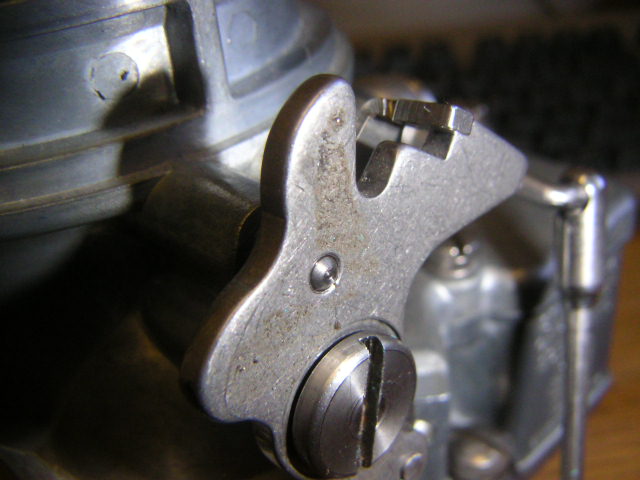
So there you have it. The same story from two very qualified horse’s mouths.
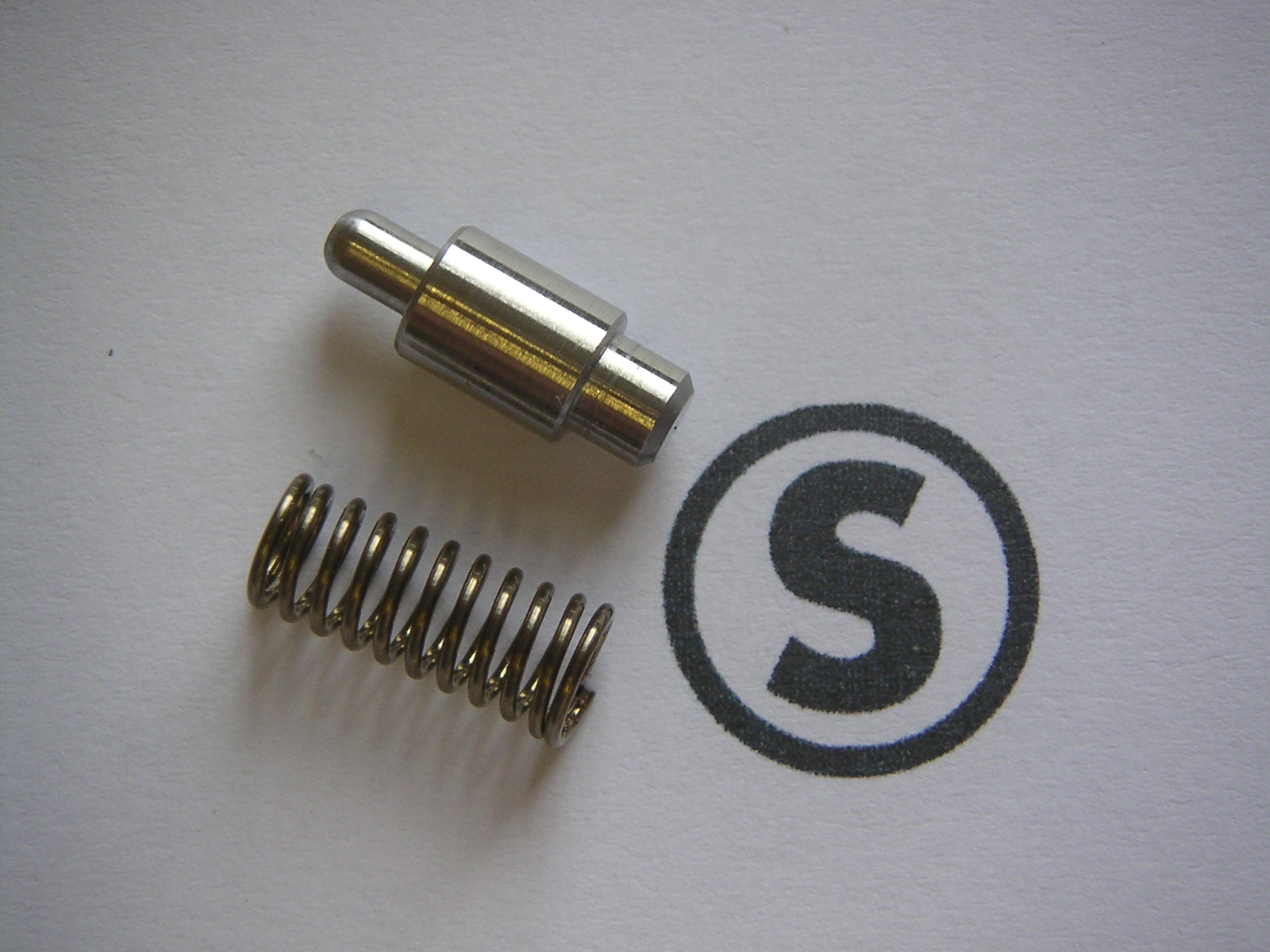
By the way, if you want to keep your choke plates fixed open, try our Choke Lock Detent kit (Stromberg Part 9537K-L), which replaces the usual round-tipped detent pin in the airhorn to lock the choke plate open.
Retails at $6.95
2. Bigger Stromberg Power Valves Have Smaller Numbers
Stromberg main jets are easy. What you see is what you get. Stock Genuine 97s come with 45s which means 0.045inch. Power by-pass valves (PV) – the ones underneath the accelerator pump — use the old engineering Number and Letter Drill system, devised as a way to fill in the gaps between the 1/64th sizes. And to complicate matters, the bigger the number, the smaller the drill!
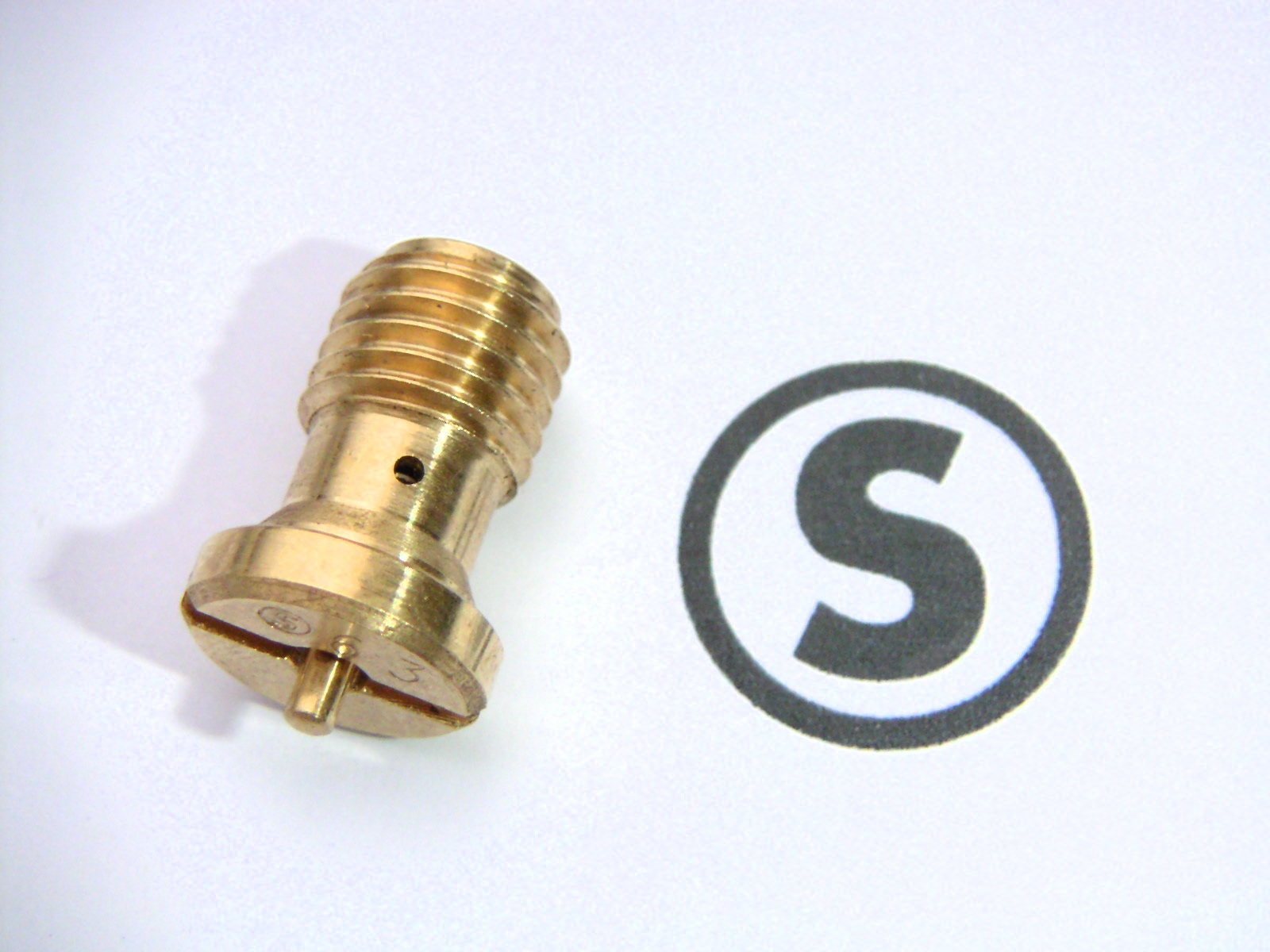
And to complicate things even further, changing your PV by one number does not always mean the same change in jet size! We offer everything from #72 up to #60 (note that I said ‘up to’). The #72 is 0.025inch, #71 is 0.026, but #70 is 0.028 (a two thou’ jump), then #69 is 0.292 (WTF!) . The gap between #66 (0.033) and #65 is also 0.002inch before it returns to 1 thou’ per size right up to #57. We didn’t make the rules! But it pays to remember this when you’re trying to rejet.
And while we’re on the subject, remember that the PV only starts to affect the fuel ratio at just after 50% throttle. And when you swap them, cut a slot in the centre of a wide blade screwdriver so you don’t crush the centre pin and spring.
3. Set The Stromberg Float Dry
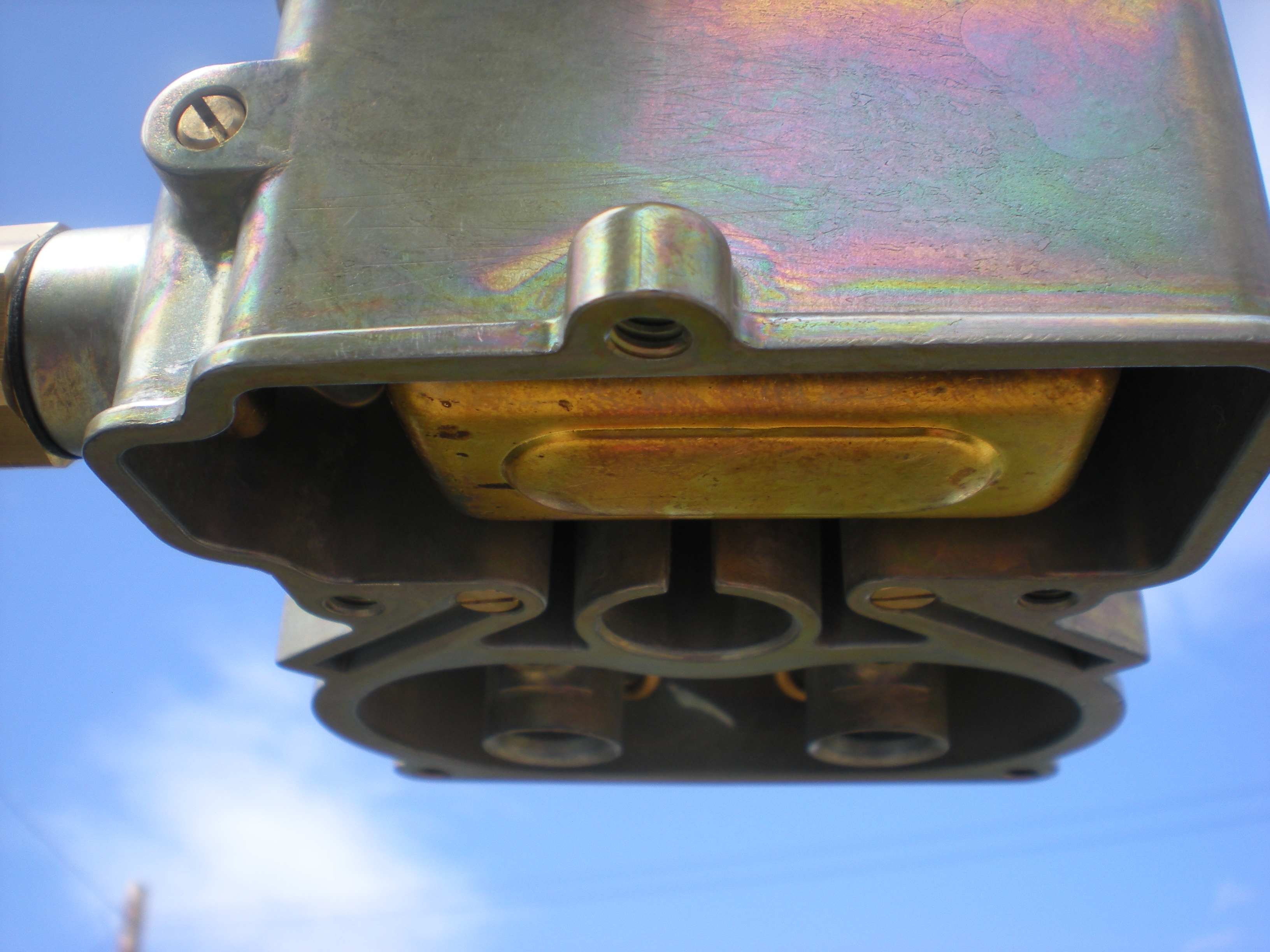
 The float in a Stromberg 97 (and 48, 81, etc.) is supposed to be set so the fuel level (not the float itself) is 15/32 inch (plus or minus 1/32) below the top edge of the casting without a gasket. But to be honest, that’s easier said than done, especially with the engine running and a cigarette on the go.
 So for increased customer safety, our Premium Service Kits (9590K-97 and 9590k-81) now recommend that the float is set ‘dry’, as we do at the factory. Rather than a float gauge, our kits now include an extra leaflet about setting the float level. To download a copy, click here. Basically, just get the float so it sits level in the bowl when the inlet valve is shut.
All new Genuine 97 floats are pre-set at the factory, but if you’re rebuilding, you adjust the front ‘tang’ of the hinge to push it nearer or further from the inlet valve. If (and only if !) the carb is empty of gas, hold the bowl section upside down so it closes the valve by its own weight, then eyeball it through.
4. Most Carburetor Problems Are Actually Ignition
I didn’t write this one. I’ll just leave it to the words of our dealer and very knowledgeable Stromberg guy, Bob Baxter at Baxter Ford Parts in Kansas.
“I bet 75% of the carburetor problems people call about end up being ignition. If you ever get people asking about hard starting problems once the engine is warm, ask them if they’re running 12V. Then ask if they have a wire running direct from the starter solenoid to the coil. Most don’t. Also, suppression wire with 6V is a no no. And if an original 6V coil has been replaced with a modern 6V coil, the ignition resistor might need to be bypassed.”
5. Progressive Linkage Is What You Make It
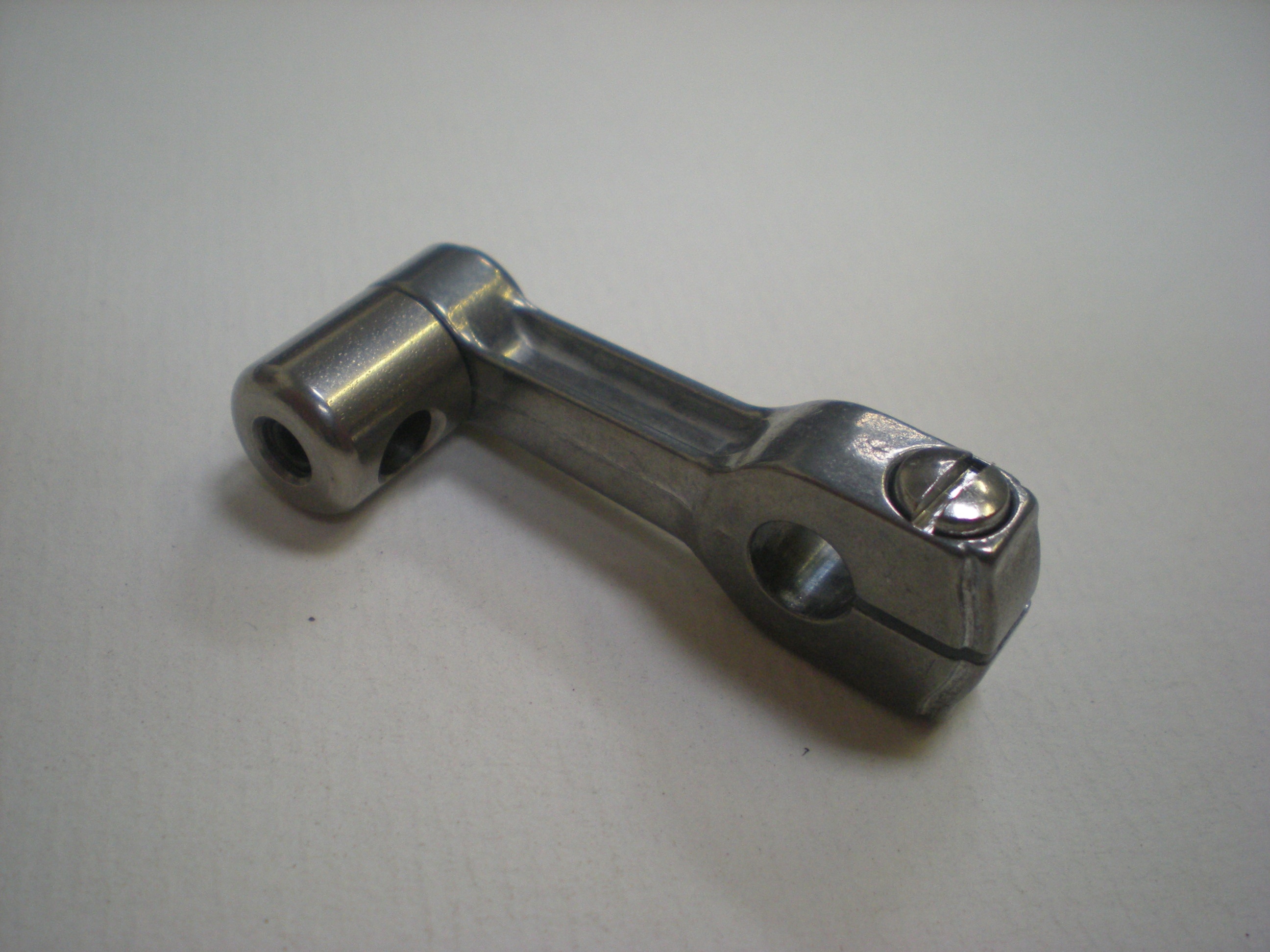 Having just launched our new Superlink multi-carb throttle arm (9091K), we’re developing our own progressive 3×3 Stromberg linkage system next, and as usual asking all the same questions hot rodders were asking back in the 1940’s. Here are a few things to consider.
First off, with a typical Stromberg progressive, if you want all three carbs to hit WOT at the same time, you’ll find that the primary hits about 50% max before it starts to open the secondaries. Stromberg throttles rotate about 80 degrees so aim for 40 degrees each side of vertical for the best geometry.
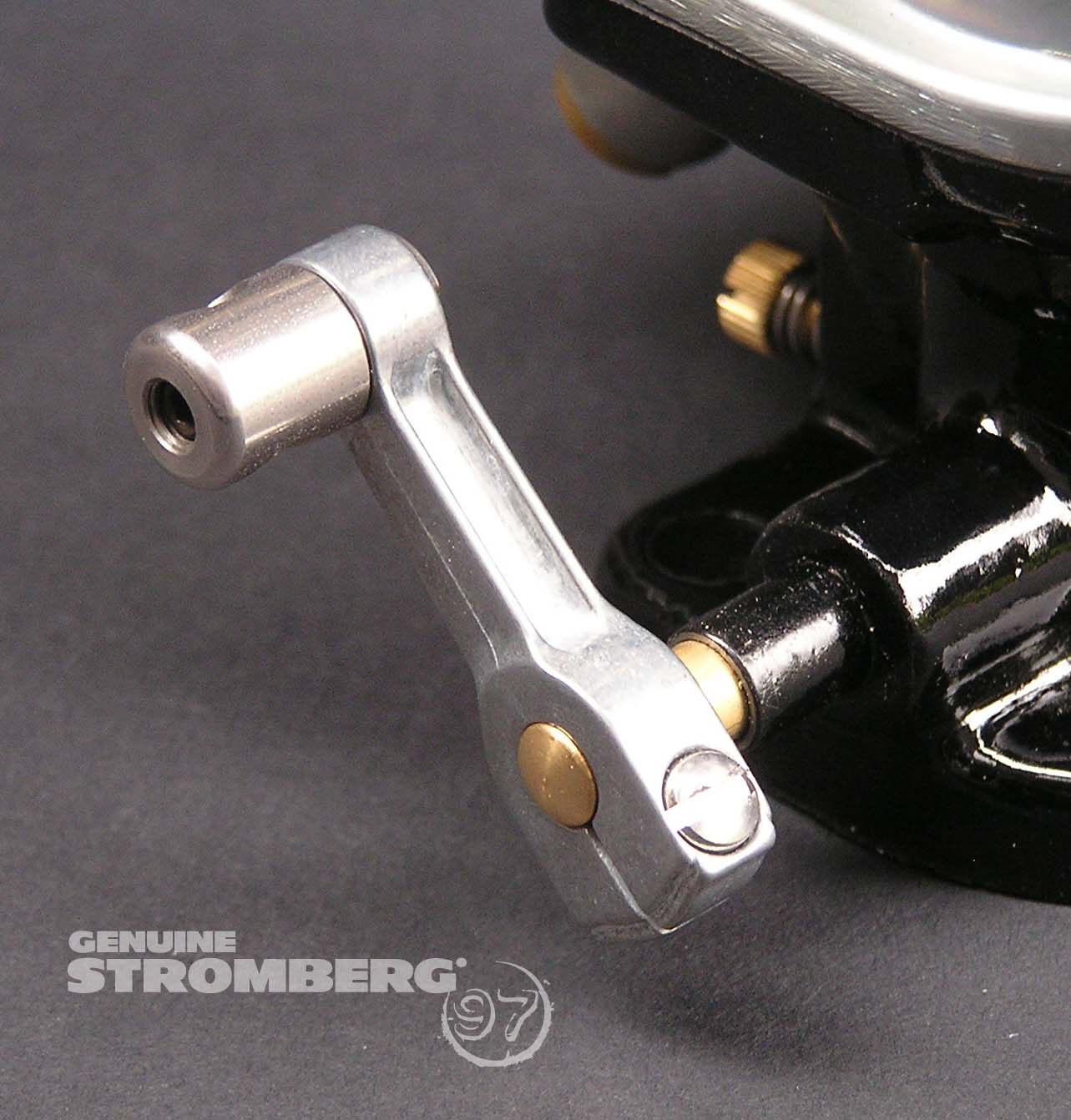 Next: Offenhauser and Edelbrock intakes have different carb centres, so the same progressive linkage will open the secondaries at different points on different manifolds. And also depending on whether the primary pulls the front carb or pulls the rear one. Ideally, in a light car, you want to run your flathead on the
freeway on the centre carb only, so tyre size and gearing all play a part.
Next: Unless you’re running a monster flathead, you probably don’t need all three carbs to hit WOT. So you can actually set it up so the secondaries come in later, but never hit WOT. Bob Baxter has even set flatheads up with a dummy in the centre and a direct linkage front to back. Or with the outers as primaries and a centre secondary.
6. Stromberg CFM Flow Rates Were Quoted In The 4-Barrel Measure
This is an argument we’ve had over and over again. Back in the day, max flow (cfm) rates were measured at 3 inches of Mercury (inHg) for two barrel carbs and 1.5inHg for 4bbl carbs. And there is a conversion factor between them – ie. a 600cfm 4-bbl Holley is not the same as 600cfm worth of 2-bbl carbs.
So when people read the old published flow rates: 150cfm for a 97, 175cfm for a 48 and 130cfm for the 81, it’s assumed that these are at the 3inHg, 2bbl measure. But that assumption is wrong. For some reason, those figures are actually 1.5inHg, 4-bbl type figures. Which is incidentally why, four 97s work great on a 350 Chevy (work it out).
Finally, our own flow test results put the new Genuine 97 at 162cfm. A Speedway carb made 154cfm. And (to avoid any bias) the Barry Grant 98 made 162cfm too. All measured at 1.5inHg.
Look for more how-to’s and tech info from Stromberg Carburetors in future articles at MyRideisMe.com
Tags
Related Posts
Share This


Just What I Needed For My 97.
THANK YOU .
Ron B.
I am trying to set up a 2×6 manifold for my sbc.I am going to run 2 primary carbs 2 secondary carbs and 2 dummys,the active carbs are at the four corners.I am looking for any info or tips.The carbs are ford 94’s.
thanks
mike
Hi Mike, Clive here at Stromberg Carburetor. Whether you are using 97s or Holley 94’s, (the cfm is about the same) four is a good number for a SBC – adds up to just over 600cfm. Yes, blank the centres (we have a kit) but I’d keep the other 4 all the same. The 4 corner carbs will be virtually above the chevy port areas. These intakes were designed for racing so the mixture will take the nearest path. If you have just 2 as primaries they will always be a long way from some ports. The other issue is linkage. We know because were currently finishing off our new Stromberg 6×2 and 4×2 linkage sets, that setting it up with say the front 2 as primaries and the back 2 as secondaries is very tricky all off one back bar linked to your pedal. And as for primaries at opposite corners, forget it! You will have to experiment with jetting and accelerator pumps too. You may not need all 4 pumping, but then again with these intakes it takes a while to get the air moving then you gas it, so extra pump gas might help. 97s are a little easier to manage in that respect. Hope this helps, Clive
What setup to your recommend for two Strombergs on a 1931 Model A Ford?
Hi Clive, We have worked closely with Charlie Yapp at Scalded Dog Speed Parts on this question. Charlie runs the Secrets of Speed magazine, dedicated to hopping up Ford 4-banger engines so he is very knowledgable. While there are a number of 2×2 intakes for Model A, not many have a plenum chamber effect allowing you to run a progressive linkage – running on one carb most of the time and bringing the other in at higher revs. According to Charlie: ” My “Equalizer” dual intake is designed with a “mixing plenum box” for equal runner length. Thus you can run one carb and one as a dummy, or two fully operational carbs, or two with progressive (my first choice). Works very good.” Stromberg even made a progressive linkage for it. Part 9248S ($45.95) is direct and 9248PRO ($99.95) is the progressive. You can find them on our website. You can connect one carb to the standard throttle linkage and let our linkage do the rest. Jetting will depend on your engine tune, local gas, elevation, and how you set them up, but you need to start at around 0.043 main jets and small power valves – maybe numbers 69 or even the smaller 71s. This is for Stromberg 97s, by the way. People used to fit two 81s thinking it was less carburetor, but the engine takes what it needs so it won’t know (or matter) whether you have 97s, 81s or whatever on there. It just uses a different part of the fuel curve. If you need more help, email us using our tech@ email address which you’ll find on our website at http://www.stromberg-97.com All the best, (the other) Clive at Stromberg Carb.
Does the Stromberg 97 require a pressurized fuel system (a fuel pump) or can it work on a gravity fed fuel line like on a Model A with a cowl fuel tank?
I have 4 Stromberg 97 EE1 sitting on an Edelbrock maniforld for a Ford flathead. I have had the set up for over 50 years now and used them on my first hot rod build when I was in high school. It’s time to clean house and from what I’ve seen on the internet the prices are all over the place. Can you give me an honest appraisal value and where I should start as an asking price?
Thanks
Mike Stark
I have found so much mis-information and conflicting info on tri power on the Internet that I’ve become completely confused. I have an Edlebrock (3-bolt) 5418 three deuce intake and want to use the Stromberg 97’s. My engine is a 327/330 HP HIGH PERFORMANCE (BALANCED) with a high energy Competition camshaft .454 lift and 268 duration. Will the 97’s provide enough cfm… and run efficiently. Love the 97’s this new engine will in on my 34 coupe.. Thanks, Ray
Ray, Clive again at Stromberg Carb. Sounds like a good strong engine. If you do the recommended math on this, the formula for required cfm is engine cid x max revs divided by 3456 (and then multiplied by the volumetric efficiency which will be less than 1 for most engines.). Each new 97 is 162cfm so you don’t have to be a scientist to see that 486cfm is nothing like the typical Holley 600cfm carb that most people use.
Luckily that’s not the end of the story. The math only tell you about top end cfm requirement and you only need high cfm at high revs. So let’s do the math for your motor: 327ci x 5000rpm/3456 = 468.75. And that’s at max vol efficiency. We said that 3x97s = 486cfm.
Now, the same math would say that a 350ci motor at 5500rpm needs over 550cfm, but I can say from personal experience that we had a hot 355inch Chevy motor on a dyne with three regular 97s and an Edelbrock 3×2 intake and it ran like hell, made 347HP at 5600rpm and 382 ft.lb torque at 3800rpm. Both were more than the 4bbl Holley we baselined. And that was without friction correction or any of the other BS people use to report more dyno HP. We didn’t even change the stock jetting, though we did disable the two outer accelerator pumps because it just didn’t need them.
So why did I calculate to only 5000rpm? Those old dual-plane 3×2 intakes were designed for early Chevy small blocks – 283 etc – which didn’t rev that great, and they are all sharp corners so they stop at 5000rpm pretty much. We saw 344.5HP at 5000rpm and it was almost flat up to 5600 before it starts dropping off. But the truth is, they provide bags of torque.
I think the important point here is that for a lightweight hot rod on the street, what you need for everyday drivability is low torque. If you drive your ’34 ford at over 5000rpm too often you’re a braver man than me! This set-up was making 362ft-lb at just 3000rpm. And on a progressive linkage, you’re only on one carb most of the time so fuel efficiency is good too. Hope this puts your mind at rest!
To Mike Green – We have spoken to Model A owners about this with mixed feedback. The 97 works best with around 2.5psi pressure max, but this could be pump or gravity pressure. I don’t know what the pressure is from a Model A tank by gravity and I’m too dim to work out the math, but you can bear this mind. When you put a 97 on a Model A, the carb sits very high up compared with the original carb so it is closer (higher) compared to the tank so there is less ‘head’ of gravity pressure. Also, a stock Model didn’t rev that high so the fuel bowl didn’t empty so quickly. When the tank is low will it provide enough fuel pressure to keep it full at higher revs? My own Model A has a flathead V8 with the fuel pump on the engine so I cannot answer that question! What I will say is that we have guys running 97s on Harley D’s with no pump and the carb almost level with the tank . So I guess the answer is give it a try!
To Mike Stark, Clive again. The market for used 97s depends on a bunch of things. Condition is everything as new parts cost money. Stromberg Carb does make everything available though, if they need anything. ebay seems to be the place where most stuff ends up and because its an auction the prices are real – not some inflated expectation. If you ‘watch’ a few auctions you’ll see what they finally sell at and you can make judgements off that. Max Musgrove in Utah has a good name in the old Ford and hot rod scenes for rebuilding 97s and he buys cores so you could email him to see what he typically expects to pay. – madmax1946(at)comcast.net
Am building a Chevy 302 @ .030 over (= 306), with JE 10:1 to 10.2:! pistons, stock 2.02 / 1.60 heads (reworked), a Howards Roller Cam, HEI ignition, & Long tube Headers, I wish to mount 3-2s and am at a loss as to what carbs I can use. I have computed my CFM requirement at 575 CFM at 100% volumetric efficiency. But I understand I can NOT use any Stromberg carb setup. I need Rochester 2Gs that are rated at about 225 CFM or better. AND I am also not sure if the CFM for the Primary needs to be greater than the Secondaries. Any know for sure? Thank you, Murf
I’ve just built a 55 Chevy with a Dart 427 small block with an Edlebrock X-1
Cross Ram 6X manifold with 48’s in the center and 97’s on the four corners. I also build a progressive linkage system for it. It has MSD ignition and a pretty wild cam with about 300 degrees ignition and 600 thousands lift. The carbs are jetted at 45 with 70 power valves. Tuning is a very difficult thing. I can get it to idle with just the center two carbs operating. The four ends are blocked off. On hitting the throttle I get significant initial popping then the throttle catches. It won’t idle until the idle screws are out at 1 3/4 turns. I’ve got a velocity meter but it barely works with two carbs. The center adjustment needs to be screwed out all the way. The engine is designed for about 575 HP. I initially tried to tune with all six hooked up I had too many problems including linkage. What I need to know is what is the best jetting and power valve size? Also any tips on tuning the monstrosity? It’s looks great, is all polished etc. will be great in a show but I need it too run well. Eventually it will be in the nostalgia class at the drags. I haven’t raced in 50 years.
Dave Johnson
Does the 97 have a metered vacuum port for the distributor vacuum advance? I know in some cases manifold vacuum can be used but sometimes it doesn’t work well at all, depends on the engine. Also I’m not well informed about how the 3×2 will work on my 327 regarding engine vacuum with 3 97’s. Any info on this issue would be appreciated as I save up money to get the 97’s. My engine is a 327/330 HP HIGH PERFORMANCE (BALANCED) with a high energy Competition camshaft .454 lift and 268 duration
Answered my own question regarding “Ported Vacuum” vs manifold vacuum
Found a great article that explained it very well… for anyone interested. http://www.corvette-restoration.com/resources/technical_papers/Timing101.pdf
I will use manifold vacuum for the vacuum advance with my 97’s. The ported vacuum was strictly used with the early crude emissions “badaid fix strategy” used by car mfg’s.
Dave, Sounds a like a real eyeful! I need to say I don’t have personal experience with this intake. We have one here at Stromberg HQ but have never run it on a dyno. We have had some feedback from users, but just about everyone seems to have ended up with a different set-up. So here are a few observations. First off, please read our comments above to Mike Fox.
Next, the X-1 is a race intake so it will always be a compromise on the street. At lower revs, the intake velocity will slow and you could get gas puddling in the bottom of the intake. The carbs will see very little signal vacuum at lower revs too so their operation will be less than perfect. With two carbs, when you open that throttle, the plenum effect is such that the intake speed is lagging – the intake charge doesn’t know where to go until the engine speed picks up. And you might well be leaning it out, too.
Next, two Stromberg 48 carbs is not going to be enough for this engine, whatever the intake – and whatever you do to those idle mixture screws. 575hp! You need all the gas/air you can get. You can use the formulas quoted elsewhere in this topic to see where you need to be, but you need at least four of those carbs working to get the cfm you need up to say 5000rpm. So you might be better off working with the outer four carbs, or all six on a progressive that brings the outers before half throttle. Stromberg is launching a new 6×2 progressive linkage system soon that can handle that sort of flexibility.
For tuning, you need to get a quality linkage and get the car/engine onto a dyno of some sort so you can measure what is happening and make informed decisions about tune. Again it will be a compromise because on this type of intake, you can keep adding more jet to get more power at the top end, but the lower end driveability will start to suffer. The final jetting will depend on a whole host of factors, so it’s impossible to quote you something sat in my chair here. I can say that you probably won’t need 6 accelerator pumps though – in fact you might only need the centre two pumping and the other four disabled. Good luck with the project. Keep persevering and you will find a good level of tune that suits your engine and your driving style.
I have just bought a1940 ford V8 flat head with offenhauser heads and intake with two 97 strombergs. runs terrible, but getting better since I have set the float level. Added a adjustable fuel pressure regulator. I am working with the timming now. It has HEI distributor with centrifical advance. On this both carbs open at the same time. do you recomend the progressive linkage and do they make one for my setup. Is there a difference in the primasy 97 and the secondary 97.
Hi David, If your engine runs badly, you need to look at one thing at a time. Carburetion tends to get the blame for every engine problem, so start with the basics and work through it logically. If the carbs leak fuel or air (through worn throttle shafts, for example), Stromberg Carburetor dealers have all the rebuild parts you need. Set your pressure reg at 2.5psi to avoid flooding. And we recommend setting the float levels dry – we have instructions online at the Stromberg Tech Center. As far as I know the only HEI distributors for flatheads are converted small block Chevy pieces. They are not the most popular option for a Ford flathead – you can google that like I did! – so you might want to choose another option there to make life easier for yourself.
And finally, on the question of a 2×2 progressive linkage for the Ford flathead V8 engine, we would avoid it. This engine can handle two 97s easily. We see a lot of 3×2 progressives, but that’s a different deal. We do not make a different ‘secondary’ 97, because they are small carbs and you honestly do not need them. Use both carbs on a quality direct linkage (check our website at http://www.stromberg-97.com) and set them both exactly the same so each cylinder gets the same charge. Set the idle and throttle stop screws and balance the carbs too, so each is doing the same amount of work. If you do all of this and the engine still runs badly, your problem is probably elsewhere! Hope this helps.
how much vacuum is needed to close the power valve? thanks Paul W.
Hi Paul, Happy New Year! The Power Valve on a Stromberg 97 is not vacuum driven like it is on an old Holley (or new Edelbrock) 94 carburetor. That was one of the reasons it became the preferred alternative for multi-carb hot rod use – it is far more easily controllable. The 97 power valve is mechanically operated via the throttle position. Located at the bottom of the accelerator pump well, it is opened when the accelerator pump hits the little pin on the top – at around 50% throttle. The springs in the pump take up the remaining throttle movement up to Wide Open Throttle, keeping the power valve open and allowing extra fuel to be pulled out of the accelerator pump discharge tubes, via the metered hole in the power valve. If you pump the gas pedal quickly, the pump will force a measured quantity of gas through the valve (against the small power valve spring with hydraulic pressure) squirting raw gas down into the carb venturis.
I just purchased a reproduction carburetor for my 1951 F1 Truck and it does not have a vacum advance hookup for my stock distributor. What options do I have other than changing out the distributor for a centrifical advance distributor. What do people do when using stromberg carburetors whic have the same issue.
Hello, I have found A 4 x 2 Crager manifold for a 324 olds Rocket, I will do the normal stuff for the Street, I was Thinking About 4 New Strombergs, How Would Set these Up What Do you think? Thanks
Hi Larry, The regular Stromberg 97 has no port for a vacuum advance distributor. We have engineered a new base option, but it won’t be available until early 2014 and it is only designed to work with eg, a new Mallory mech/vacuum advance distributor. Sorry! I am not an expert on the trucks, but I do know that 1949-51 Ford passengers cars used an all-vacuum advance distributor with no mechanical advance. The very late model, aftermarket ‘Model 1-1’ Stromberg 97 did have a vacuum port for these distributors but they take vacuum from more than one place in the carburetor. The new vacuum base we are making is not compatible with the Load-O-Matic, which requires a special bowl casting too.
You can read our discussion about the various options available on our website. It’s in the Tech Center under the tab for ‘Jetting and other FAQs’ http://www.stromberg-97.com/tech_center/jetting_faqs.asp#techlist
Hi Larry, The Cragar is a great set-up for the Chevy. We have a Cadillac version here at the shop and we make a linkage for it too. 9270-D will do the trick. The intake puts one carb directly over each port yet still provides a plenum space so they can all share mixture. Jetting will depend on not just the engine, but local gas quality, elevation and more. We usually say get the car running with standard jetting then see what it needs.
I’m curious if Stromberg ever developed any prototype intake manifolds for the ford flathead. I have an intake dated 1947 that has the S-circle logo very prominently CAST in the top. It is a single carb intake and appears to be unused. All the research I’ve done shows no other intake using this logo. Do I have a ‘lost’ treasure?
Hey Clive,
I’m running a single 97′ on my model a four-banger with a mild cam, counter balanced crank, seven to one head, electronic ignition, and a chopped flywheel. Most of my driving is near sea level, 100′ to 1,000′. The engine is running fine the way it is, but, I’m always interested in that extra boost. I’m running with .43 mains and a 69 pv right now, but I’m not clear on which pv to use with which main jets. If I go to ,45 main jets, what size pv should I use? What size pv should I use if I go to .41 main jets?
Hi David, I saw pictures of this intake recently on social media and I have to concede I didn’t know anything about it either. Many folks surmised it might be Stromberg, but I always doubted it. It turned out the maker was another name, and I regret that I cannot remember it now. So yes, you do have a lost treasure – they’re rare! – but it’s not Stromberg. We used an S in a circle as a Stromberg casting mark purely as a random decision. Looks like someone else had the same idea – a long time ago.
Hi Hank, We talked with someone else about this recently, so I may as well share it here. As a rule, a fixed venturi carb like the 97 doesn’t need to be too far away from its stock designed state. So jetting is more dictated by the carb design (the venturi size) than the state of engine tune. Carbs don’t know you have a chopped flywheel – they just read the vacuum signal from the manifold and provide fuel accordingly. And that’s pretty much all! The art of tuning is to adjust the jets so that it provides the ideal Air/Fuel ratio for the vacuum signals it gets from YOUR motor. So if you are currently seeing good readings – good plugs etc etc – then adding more gas will not make the car go faster.
OK, I can hear you asking, why are two carbs better than one? And why do engines often respond positively to a bigger carburetor? That’s a different deal. Engine vacuum is simply a function of the swept volume (cid x rpm) and the size of the carb throat you are sucking that volume of air through. Try to suck enough air for a big block Chevy through the eye of a needle and you’re talking high vacuum and high velocity because it’s hard work! A thicker milk shake demands a fatter straw!
If we swap that needle eye for six 97s, it is easier for the engine. It can pull less vacuum to get the air it needs, and – here’s the payoff – the engine uses less of its own power output in pulling that vacuum. That means more power for the rear wheels.
If you have two 97s instead of one, you don’t get twice the gas. They simply share the load, so each carb operates at a lower part of the fuel curve. Another benefit of course, is that if you tune the motor and the efficiency goes up, you might need more air at the top end. Doubling your cfm capabiiity from one carb to two means it’s less likely to choke off at the top end.
The thing to remember about main jets vs power valves is that the main jets govern the A/F ratio up to about half throttle, after which the power valve adds more gas to the mixture. So the skill in tuning is to choose each set so you get the best A/F reading at the right point. I am simplifying here, but obviously at the top end, your carb is supplying fuel from main jets AND power valves. So, if you decide that you need more main jet to improve low end and cruise speeds, but the top end A/F ratio was good previously, then you might want to reduce the PV size so you get the same TOTAL gas amount at that top end. And vice versa.
We haven’t mentioned changes for elevation and local gas (usually ethanol content). As a rule, the higher you go, the thinner the air so the less gas you need to match – smaller jets AND power valves. More ethanol has the opposite effect. It’s like having less gas in each gallon, so you need more of it for the same amount of air.
I’ve read all the posted comments and seen discussions on 81s & 97s. Well what about the forgotten 48. I’m interested in putting dual carbs on my banger. I’ve milled my manifold so I could add a mixing chamber. I found two 48s for sale, I realize the venturies are larger than the 97s. So please give me some feedback, pro’s & con’s. I’m in California basically at sea level. Thanks
HI im trying to set a four big 97 setup on my 364 nailhead, it seems to be getting to much gas, and fouling out the plugs , do you think I need to rejet ? Running 2.5 pounds of pressure, on two barrel manifolds with pagresive linkage? Thanks for any input I’m pulling my hair out !