Galaxie Custom and Bonneville Salt Cruiser

December 2, 2009 by Hechtspeed · 1 Comment 

1962 Galaxie, Speedweek 2009, Bonneville, Mild Custom, Rod and Custom, Salt Flats

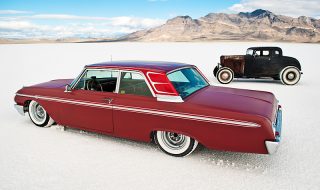
This 1962 Ford Galaxie 500 was easily one of my top 3 favorite cars from Speedweek 2009.  I first noticed it in the pits then saw it again while Pikesan and I were cruising down the Long Course after the drivers meeting.  We sort of cruised the rest of the Long Course along side Nick and his Gal’ then turned onto the Return Road back to the pits. Almost 7 miles from the start, we spied some pristine, undisturbed virgin salt and decided to make a detour for some salt-throwin’ pictures Craig’s ‘27 T, Nick’s Galaxie and Nick’s buddy’s 5 window Coupe you see in this picture above.

Here’s some more shots of this Mild Custom!

1962 Galaxie, Speed Week 2009, Mild Custom, rod and custom, Bonneville, Salt Flats

I love this car!  That red satin paint against the bright white salt is rockin’.

Mild Custom, Galaxie, Speed Week 2009, Bonneville, Salt Flats, rod and custom, Ford Galaxie, air ride
I dig the long lines.  That stance is perfect with its Air Ride Technologies 4-way system with electronic controller.

1962 Galaxie, 1927 T bucket roadster, Speed Week 2009, Bonneville, Salt Flats
I dig this shot with Pikesan’s roadster in the background.

From Nick: “This car has been a great driver for the past 4-1/2 years. It originally had a 390/auto and I decided to swap in a 302/T-5 and 3.70 gears last year. It’ss an absolute blast to drive and I wouldn’t hesitate to drive it anywhere. Come to think of it, during the 40,000 miles that I’ve put on it, I don’t recall ever being stranded.”

Here’s the specs on the Gal’

Engine:
Roller cam 302 (5.0), rebuilt .030 over, Trickflow Stage 1 cam, Edelbrock Performer RPM intake, Edelbrock 650 carb., shorty Mustang headers

Exhaust:
2-1/2″ with H-pipe, 40-series Flowmaster mufflers, dumps just ahead of the rear bumper and sounds great.

Transmission:
Stock ‘94 Mustang GT world class T-5 5-speed.

Rear suspension:
3.70 gears. Air-Over-Leaf ‘bag kit, 2 leaf springs remain, with 2″ lowering blocks added.

Front Suspension:
Ford Granada spindles, disc brakes, and (manual) master cylinder.  ‘Cool Ride’ air bag kit installed with shocks relocated to rear of control arms.

Wheels/Tires:
15×7 with 225/70r15 Diamondback Classic tires.  Chrome wheels – original centers with new 7″ wide rims by Rally America. Chrome Spider Caps.

Body:
Red primer and Silver flake / Red candy roof

Enjoy these pics from Nick.

Speedweek 2008, Salt Flats, Bonneville, 1962 Galaxie, mild custom, rod and custom

This was taken in 2008 at Nick’s first Speedweek trip.  He drove it all the way out from Nebraska.  Crazy!

Mild Custom, Salt Flats, Bonneville, 1962 Galaxie, Speedweek

This Galaxie just has it all for me.  Late model 302, a T-5 5 speed trans, air ride, white walls, Mild Custom look with great stance-NAILED!!  Nice work Nick!

But Nick, despite his fond memories and long drives in the Gal’ moved on to another project. A 1929 Model A Roadster with traditional style to come, no doubt.   I can’t wait for Model A’s debut. See you at Speedweek 2010?

See you on the Salt!
Hechtspeed

Bonneville Salt Flats, Speedweek 2009, mild custom, ford galaxie 500, white wallsMild Custom, 1962 galaxie, ford galaxie, air ride, air rid, mild custom, 1962 ford galaxie, goodguys des moines

1962 galaxie, before picture, air ride, white walls5.0L, small block ford, 302ci, ford v8, engine swap, 1962 galaxie, mild custommetal flake, steering wheel, carpet kit, ford galaxie, original interior, mild custom

Bummer! 33 Ford Coupe Goes Down at Optima Invitational Race

November 9, 2009 by GreaseGirl · 3 Comments 

Hot Rod 1933 Ford Coupe crashed

Hot Rod 1933 Ford CoupeOne of the first things I saw Saturday morning as I arrived at Spring Mountain Motorsports Ranch was this Factory Five built, black 1933 Ford Coupe. I was worried it would be all about Camaro’s and other muscle cars during the Optima Invitational Ultimate Street Car Challenge – but seeing this smooth coupe roll across the pit assured me I’d have someone to cheer for this race day.

I can’t tell ya all about the long list of goodies it had – but let me assure you it was long. And being built by Factory Five means its some serious business. After the few laps around the Road Course that all of the cars took, Lucky #13 was just the second car for its chance to prove its stuff in this segment of the race.

Hot Rod 1933 Ford Coupe snapped suspension - Factory FiveTo the dismay of everyone watching, as it began its second lap of the track, pulling past the first curve we saw a big cloud of dust. What we’re all asking now is what came first, the break or the accident? I guess Lucky #13 was not so lucky, it’s front suspension snapped right in half. (edit 11/30/09 – Check below. Hot Rod’s editor Rob Kinnan’s setting the record straight)

We were all disappointed to see this baby sponsored by Hot Rod Magazine get put on the sidelines…but here’s hoping it’ll be back next year!

Bone Stock Marries Plain Jane: Falcon Wagon

October 28, 2009 by pikesan · 8 Comments 

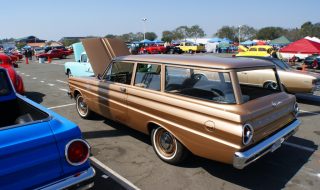
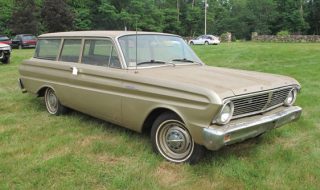
Ford Falcon 1965 Falcon Wagon restored bone stocker at Cruisin-for-a-cure-2009All right then, I’m a wagon freak. You could even say I’m a Ford Falcon wagon freak. I’ve written before about the problems I have (Extra W Chromosome) and the 63 Falcon wagon project I’m re-doing. I’ve learned to live with those issues and I’m doing my best in the hot rod society. But then I saw this totally clean 1965 Falcon wagon owned by Norm Huie of San Clemente, CA at the Cruisin for a Cure Show.

More precisely, it’s a ‘65 Ford Falcon 2 door wagon in the original Prairie Bronze paint. It’d get boring if I kept saying original since Norm’s taken great pains to restore his wagon back to 99% stock himself.

Ford Falcon 1965 Falcon Wagon restored bone stocker with optional V8 and power steering1965 Falcon Wagon restored bone stocker rare factory cargo light

Norm’s always been into Falcons but chose this odd-ball 65 because it was the last year of this model.  I say odd because it’s a 2 door, no-doubt more desirable than the mor-door cousin I own. Then, it’s got the factory V8 another plus, but from there, this car is plain-jane! It’s a non-Deluxe, non-anything car but it does have power steering and power brakes and a rare cargo light inside near the tailgate. Odd right?

Otherwise, the interior on Norm’s wagon is totally correct, but a taste boring compared to the Futura or Deluxe models, but hey, it’s correct! Notice it doesn’t even have a horn ring!

Ford falcon 1965 Falcon Wagon restored bone stocker dashFord Falcon 1965 Falcon Wagon restored bone stocker - plain door panels

You’ll be hard pressed to find another Falcon with better bright work and trim. That’s because Norm owns an automotive trim restoration shop called “Shine on Me” at shineonmetrim.com. Every part from the dash insert to the bumpers and grille are perfectly straight and so bright they looked better than new to me, but Norm assured me, that’s how they should look. It’s too bad there’s not more trim to shine up!

Nice meeting you Norm!

Please leave your comments below.

How-To: Bullitt Gas Cap On A Late Model Mustang

July 6, 2009 by Hechtspeed · 16 Comments 

Mustang Bullitt fueldoor-contest-big
Leave a comment below… Why should you win? That’s all there is to it!

Drag Race- late model Mustang

Want to add a little “Frank Bullitt” style to your late model Mustang?  AmericanMuscle has just the accessory for you!  The slick looking aluminum Bullitt gas cap is the first modification you need before you start jumping your ’stang on the streets of San Fran’ a la Steve McQueen.

MyRideisMe.com provides the installation guide of a Bullitt gas cap on a 1994 Dark Green Mustang GT (McQueen would dig it!).  The Mustang you see here might look subtle but it packs a punch at the dragstrip, with its horseman banging the gears to a best of 12.85 @ 106mph on 8″ slicks and stock motor and cam.  This Bullitt gas cap will let those Camaros know this is no ordinary pony.

Follow along as we take you through the installation.  It’s very straight forward and can be done by a novice with simple hand tools in about 30-45 minutes.

Bullitt Gas Cap assembled and ready for installationBackside of Bullitt Gas Cap 003

Step 1: Open the box and make sure everything is accounted for and in good shape (nuts, studs, lock nuts, washers, magnets, cap and ring).  AmericanMuscle is pretty good about getting you a good unit if yours happened to be damaged or missing a component (ours was missing one of the magnets).

Tools for the job

Step 2: Here’s the tools you’ll need;  T-20 Torx bit, 7mm wrench and socket/ratchet, allen set and a file/sandpaper/dremel.

Stock gas cap removed and ready for the Bullitt cap

Step 3: Remove the 2 Torx head bolts from the stock cap which attach the cap to the body and you’re ready for the Bullitt cap.

Removing the cast hooks from the cap before installing

Step 4: Using the allen wrench, remove the investment cast hooks from the bullet cap.  They’ll need to be turned around 180 degrees and reinstalled onto the car/cap.  Our hooks required very minor deburring of the castings where the pins eject the part out of the mold.
Removing the "bumpers" so they can be trimmed"Bumpers" trimmed approximately 3/16" inch

Step 5:  Remove the “bumpers” with the T-20 torx bit, trim the bumpers just above the bolt head as seen in this picture (cut or grind about 3/16 ” off the end).

Tightening the allen screw

Step 6:  Slip the unit into place, put the studs in stock holes and re-attach the cast aluminum hooks and tighten with the allen wrench.
Fastening the gas cap lanyard

Step 7:  Install stock gas tank cap plastic lanyard first, then a washer, followed by the nut, then the lock nut using a 7mm socket /ratchet.

Step 8:  Finally tighten the lower stud using a 7mm wrench.  This takes a minute or two because there’s limited access.  Just take your time here and patience will pay off shortly.

Bullitt gas cap

Bullitt cap installation complete

The install is short and sweet and gives your Mustang a slick, purposeful look.  Steve McQueen would be proud!  Get your Bullitt gas cap at AmericanMuscle today.

Hechtspeed

AmericanMuscle

3 Steps to Personalizing your Hot Rod

December 22, 2008 by pikesan · 7 Comments 

1927 Ford Roadster, Bonnie as I bought her.I’ve always liked my car… Good thing, right? I guess I always wanted a hot rod. Bonnie, as in Bonneville, sure has changed since I bought her at a Goodguys show. The 3 pictures shown here are the 3 evolutionary changes of the car.

Step 1: As I bought her: I was thinking of buying a Zipper bodied Lakes Modified until I found out there’s a 6 month wait to get one. I felt pretty lucky to grab this when I did.

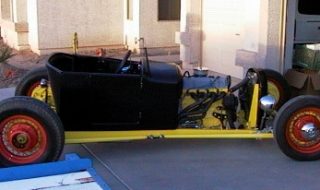
You’ll see the long split wishbones hooked to a 3 inch dropped axle. The rear axle is a old school banjo. The wheels are the 1935 style wires with some hard as hell bias ply or tractor style tires. I’m not sure what kind of paint the original owner used, but that yellow is tough as NAILS!! The engine block hasn’t never changed, but it did get updated. I’ve got the original header on it too. The quarter elliptical spring suspension front and back is there, but there’s friction shocks (only better then nothing at all!) in the front and nothing in the rear.

Step 2: My Redo: Since I was never a fan of the wires, even on lakes-style modifieds, I went to 15 inch steelies with wide white walls. I’ve always (like so many other people) liked the look of a red wheels with a white wall. It’s classic. I went to radials too. The front and rear suspension was updated. The front cause I had to. The axle had a crack in the passenger side king pin bushing. If that would have failed, the wheel comes off. NOT good. I changed to hairpins front and back too. I like the look of the wishbones, but setup the way they were, the rear axle is bound up. I found a pretty nasty crack on one side where the rear wishbone mounted. The rear axle is now an 8 inch with a 4.11 gear. I installed shocks front and back too. There’s alot of pictures of the front and rear suspension in my garage. I built the head from 1/2 of a small block Chevy kit that I split with a dude on Ebay. The red paint lasted about 30 minutes. Still, no interior.

1927 Ford Roadster hot rod - present day

Step 3: How she is now: Well, as Bonnie gets closer to being a “finished” car, the less interested I am in her. I still like this car, but I find myself thinking of building/working on my 63 Falcon wagon and 61 Rambler American wagon more. Maybe I’m getting old?

In the latest incarnation, I went to 16 inch steelies with Firestone bias ply tires. The ones in the back are TALL! It has a little more rake to it then I’d like, but nobody else thinks so. I made a new header a while back, but that’s changed since step 2. There’s more pinstriping on her now and I’ve added the custom MyRideisMe.com piston logo to the door. My buddy Joel from 1320 Designs hand painted it for me. We’re still planning to “antique” it a little. Last but not least, the interior’s in it. More on that later.

What do you think? Which one’s your favorite? Have I made steps forward or back? It’s all a matter of taste, but that’s what makes My Ride is Me, right?

Please join MyRideisMe.com and get your own Custom Garage Space (that one’s mine!) to put pictures of your car, project or whatever you’re driving!

Falcon Build Update #4 Tailgate Drama

August 11, 2008 by pikesan · 6 Comments 

I should have called this “The Good, The Bad and the Ugly” as I update everyone on the MyRideisMe.com 1963 Falcon Wagon build. It no doubt I drastically underestimated the work needed to get ready for paint! Also, my plan for the Falcon changed from a quick paint job to, “I might as well do it right” which of course is the right way to go. I’ve made some good progress on the body work even though Arizona’s held 100-plus degrees making it damn hot in the garage. It’ll be another 20 days before it cools down, so waiting’s not an option. Damn! I’m writing about the weather!

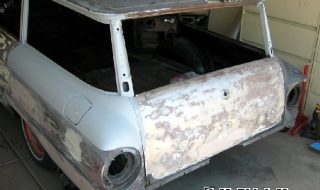
Falcon Wagon tailgate - so far so goodWant the good, the bad or the ugly? OK, bad first. Remember the blog when I showed off my skills filling the back-up lights in the tailgate. Please disregard everything I said! I screwed up that tailgate beyond reasonable repair, at least for me. Luckily, I have Mr. Freeze, (my buddy Rob) backing me up with another tailgate on hand (and rust free!). The original tailgate was repaired (another big pile of manure the previous owner didn’t mention) and had some pretty thick filler in it, so it’s just as well. This big pic shows the tailgate after I 1963 Ford Falcon Tailgate warped filled the backup lights and the Falcon trim piece above the window crank. Then, here comes the ugly, somehow it warped so bad, I couldn’t believe it! The filler required to make it straight was unreal! I ground it all off just to show how bad it warped. Those red arrows show the 1/4″ of gap. (click on the picture to see it bigger) Bad times. I decided to punt. I want to know what the heck happened, so for that, I went back to Doug Jerger from Squeeg’s Kustom. I can’t say how lucky I am to have a professional painter like Doug available to help. He’s already been a big help and doesn’t make me feel like a dumbass for asking simple questions. Doug said that when you weld up a hole like the backup lights, the panel will warp no matter how careful you are with heat. The trick is to manage the warp as you go. Not sure how to do that yet, when I figure that out, I’ll pass it on. (Any advice to add? Leave a comment please)

1963 Ford Falcon Wagon’s new tailgateCall me a sellout, but for the next tailgate, I’m keeping the backup lights and I’m gonna use that Falcon trim piece too! [By the way, did you know that wagon's and Ranchero's use the same tailgate? Makes sense, right?] By looking at the new tailgate, you’d say I’m lucky, and I am, but that’s not the original paint, so this piece too had a few hidden treasures. This tailgate became my mission. If I can’t get this thing straight, I better punt on the bodywork all together!

The good: I did it. Here’s some things I learned making this tailgate straight. I wish I had planned better, or you might say, “I wish I knew what the hell I’m doing!” Moving forward, I’ll apply all these lessons to the hood I started on and the rest of the car.

What I learned: Bodywork 101 continued..

Mixing and applying body filler in Arizona’s heat is tough. I even tryed putting the filler into the refrigerator before I start working. Not sure if that’s helping. Maybe. I’m constantly battling – Not enough hardener vs. Kicking too quickly. Alot of that has to do with my filler spreading skill. I’m slow and sloppy. I’ve pretty much decided to mix fairly small batches of filler and apply it several times. It sucks for productivity, but it’s better then throwing away a huge batch of filler cause it’s kicked. Also, once it does start to firm up, quit spreading. It’ll be a mess, believe me! (learned the hard way)

1963 Falcon Wagon bodywork1963 Falcon Wagon bodywork - guide coatNext, I started out chasing dings and dents in the tailgate. I think this might be an OK way to start, but at some point, as Doug said, you have to apply a thin coat of filler over the entire panel. Otherwise, you make new low spots filling in other dents near spots you already filled. Makes sense now! In these two pictures, you can see the dent filling and then the full cover I did. I also used some guide coat so I knew where the low spots were as I sanded. The goal is no black spots showing low and now bare metal poking through as high. (Actually “high” usually means there’s low near by) You might say there’s alot of filler on there, but not really. It’s on thin and after sanding, it’s almost see through in most places.

Make sure to clean out any trim holes unless you can reach them from the back. Doug told me after spreading to clean out all the holes then drag the spreader around all edges to clean them up too. You want to let the filler go over the sides a little. The tailgate was low right next to the edge, almost all the way around. If you wait until the filler gets hard, you’ll need to sand it off cause I found that trying to break it off will make it chip off where you need it. Bummer.

1963 Ford Falcon wagon tailgate ready for primerFinding high or low spots has really been tough for me. I guess some people feel better with their strong hand and some with their off hand. Really? I think I’m learning, but it’s tough. To check a panel, hold your fingers tightly together, then I run my hand across the panel fairly quickly. I also look away from the panel so I’m not distracted by the color variations from several coats of filler. If you feel anything (vague enough?) there’s probably something wrong. This is a pic of the tailgate ready for primer.

Then finally, the order of your work is important. I want to use Squeeg’s primer because it’s does not shrink like other production primers and offers the best rust protection. Looking back, I would have followed this plan: 1) Strip paint (either by sanding or preferably media blasting) down to metal or the original primer. 2) Paint 2-3 coats of Squeeg’s primer, then 3) Do the bodywork on top of the primer – this is another advantage of Squeeg’s primer. But, before I asked Doug, I started doing bodywork. So, I’ll follow this plan: 1) Same as above – strip paint, 2) do bodywork, especially the roughest parts, 3) shoot 4-5 coats of primer. Then, for both plans, that’s all followed by tons of block sanding to get it totally straight.

I better quit here before I start sounding like I know what I’m doing! I do feel like I’m getting better. Last weekend, I spoke many words kids shouldn’t hear and I felt like I’d never get this done. Now, I’m optimistic.

In closing, one more bit of wisdom… Doug Jerger asked me, “So how much time do you have in that tailgate?” I said, “Damn, I don’t know, alot!” He then said, “That’s why a paint job costs so much.” I get it now. To get a perfect paint job like the ones he does, you need high quality people and alot of labor. There’s no shortcuts.

Click HERE: All the Falcon Wagon Project Build Blogs.

Thanks to my current sponsors:

More sponsor opportunities available!

FORD AND NHRA TEAM UP ON SAFETY

January 12, 2008 by pikesan · Leave a Comment 

You’ll never guess who’s a new member at Ford’s media site? MyRideisMe! We’ll keep an eye on what’s happening with the performance cars and racing action over at the Ford site and post it here so you won’t have to look around.

This first story hits close to home for me. When Eric Medlen died I had trouble watching drag racing. I’ve always liked John Force so I cheered for his teammates as well. Eric just seemed like a good guy from watching him in interviews too. That whole incident hit me hard.The John Force Racing team reaction was over the top. They’ve re-examined EVERYTHING about safety in their funny cars and is doing the right thing by sharing all of the data with the NHRA and the other racing teams. The latest step is illustrated in this story from Ford Media. At Force’s request (I’ll bet) Ford’s doing the in depth engineering study needed to make sure these 7000 HP monsters are as safe as they can be. Great work guys!

Courtesy of Ford’s Media:

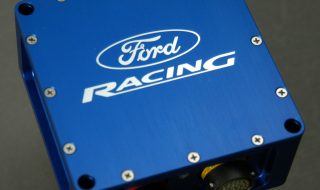
DEARBORN, Mich. – Accelerating safety development in the sport of drag racing, the NHRA and Ford Racing jointly announced today that all cars in the Funny Car and Top Fuel classes will be outfitted with the Ford Racing “Blue Box” crash sensors for the 2008 season.

“Ford, like the NHRA, is committed to continuously improving safety. It’s important to further improving our passenger cars and trucks and also to what we’re doing in racing,” said Dan Davis, director of Ford Racing Technology. “We’re supplying Blue Boxes – at no cost – for all nitro cars for next year. It’s the right thing to do for the sport and the millions of customers who will benefit from whatever we learn on the track.”

The announcement comes after seven months of initial testing and data analysis of the Blue Boxes on the Mustang Funny Cars of John Force Racing (JFR).

Ford Racing offered the crash sensors and engineering support for their use after the death of JFR driver Eric Medlen in a testing accident in March, which led JFR, in cooperation with Ford Racing, NHRA and the sport’s suppliers, in August to launch “The Eric Medlen Project,” a wide-ranging program designed to further improve safety in the sport.

Ford Racing and NHRA will work together during the next several weeks and prior to the start of the 2008 POWERade Drag Racing season on specific program elements.

ford_racing_blue_box2.jpg“NHRA has, since its inception, always been committed to improve safety in the sport,” said Graham Light, senior vice president of racing operations. “And, during that time, NHRA has worked on an ongoing basis with manufacturers and the racing community to enhance the safety of these vehicles. We are very proud of our safety record, given the inherent risks in the sport, and look forward to analyzing the data we anticipate to receive from the Blue Box initiative to further our commitment to safety.”

In addition to initial testing on the Force Mustangs, the Blue Boxes were tested for the final two races of the 2007 season on the Top Fuel dragster of Larry Dixon, to start a prove-out process on that class of vehicle.

This marks the second time in recent years Ford Racing has stepped to the forefront in safety development in racing. From 1996-2006, Ford Blue Boxes were mandatory on all cars in the Champ Car World Series.

In the Champ Car program, Ford’s Safety Research & Development group analyzed the raw crash data, along with the supporting medical reports, photographs, and video.

Ford then developed a CAE model of the driver inside a racecar cockpit to recreate the accident through computer simulation. The purpose of the research was to predict responses and injury potentials to the drivers in high “g-force” impacts.

computer_model.jpg

(CAE stands for Computer Aided Engineering, it often means some high-tech software was used for simulation by Finite Element Analysis. It’s pretty common now because it’s alot cheaper than crashing cars! Here’s an example of what a CAE model looks like for the funny car. Click on the thumbnail to the left)

The results were then compared with the actual response and physical condition of the driver from the medical reports. Based upon the research, Ford evaluated the effectiveness of contemporary safety devices used in the cars, and communicated the research with Champ Car and its chassis suppliers.

“This work has great potential because it provides information we simply can’t get anywhere else,” said Davis. “That’s why we’re so committed to doing the same type of program for NHRA. The experience we gained in Champ Car gave us an excellent baseline to work from. It helped us correlate the crash models our engineers and safety experts had been working with.”

funny_car_post_photo.jpgDuring the first seven months of the latest initiative, Ford’s safety effort has focused in on four main areas:

  • Data collection through the Ford Blue Boxes and accelerometers in the drivers’ ears
  • Helmet and driver restraint testing
  • Computer modeling of the current chassis, as well as seven-post shaker testing
  • Occupant modeling of the driver cockpit area

Initial changes already made by Ford Racing, based on the data collected, have included the addition of extra head padding in the driver’s cockpit, and several changes to the chassis that helped strengthen it during the 300 mph runs.

Those changes have been tested several times during on-track incidents this season, including a crash in Dallas by John Force that left him with serious injuries on his extremities, but no head or internal injuries.

“It’s important to note that these are just first steps in what we hope will be a long-term effort toward making drag racing an even safer sport,” said Davis. “Having the Blue Boxes on all cars in Top Fuel and Funny Car will allow us to gather more data in a shorter period of time, so that everyone in the sport can use it to benefit all of the competitors.”

Care to comment? Let us know you miss Eric Medlen, too. And while you’re here, please JOIN MyRideisMe.com