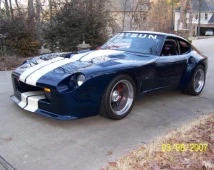
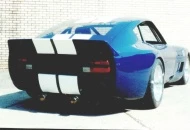
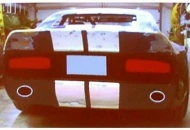
Datsun 240Z "BlueOvalZ"
Ford 289 which is very soon being replaced with a 383 (Not the Chevy, but the Ford 351W stroker version). Home-made headers, AFR 205 heads, and the typical go-fast internals. The engine is solidly mounted (along with transmission) into the chassis making is part of the chassis which greatly increased the chassis rigidity.
Transmission is a WC T-5 pulling to a Datsun R200 differential using Porsche 930 CV jointed half-shafts. Currently, at the rear wheels, the 289 dynos at 299 HP, and 260 lb/ft at 7200 RPM. It has a lot of RPM potential, but now I'm looking for more torque, and hence the reason for installing the 383. Hopefully, it will reach my design of mid 500 HP and torque fiqures at around 6500 RPM. The new heads, and almost 1" more stroke should get me close.
Chassis:
The chassis is still basic Datsun equipment. The front crossmember has been moved forward 1.25" to increase the caster for an improved camber curve. This meant that the T/C rod had to be increased in length as well. The inner bushings have been replaced with spherical rod ends on the front, with fabrication just completed for replacing all eight bushing on the rear suspension with 3/4" spherical bearings. The rear uprights and mustache bar have been replaced with a single 1/4" aluminum plate that mounts the differential, suspension, and swaybar all on one piece. The rear bushings are held independently onto this plate, separated by a turnbuckle, to allow toe adjustment of the rear wheels. Spring rate is 225 F/260 R using coilover set-up and Koni shocks.
Wheels & Tires:
17 X 11 Billet Specialties wheels with 315/35R17 tires an all four corners (DOT set-up).
Body:
Body is a home-made fiberglass creation painted in a GM Tahoe blue w/ Wimbleton white stripes
Interior:
Fabricated out of fiberglass from a once fully gutted race interior.
1971 Datsun 240Z that became a divorce recovery project. After dropping the SBF engine into the car, I found that the high...
Read More...Concepts
Using the computer I looked at various ideas I wanted to employ in changing the rear's appearance.
Concepts
Ths concept was the one I chose. Now to see if I could make the real thing look like the computer image. This is the modified image of the OEM shot two images back.
Fiberglass work
Work began by removing all the tail light parts and panels, and making a cardboard template.
Fiberglass work
Cut foam for a fiberglass mold. This piece will eventually hold the Ford tail light into place in a recessed pocket in the tail light panel
Fiberglass work
I then laid the template on some 1/8" aluminum. I use aluminum for fiberglass molds because the glass will pop off the aluminum fairly easily when it kicks. The smooth aluminum finish shortens the finishing process on the fiberglass finish as well.
Fiberglass work
Foam molds representing the tail lights are placed onto the aluminum sheet. Notice the aluminum is propped up so that it's curve will match the curve of the rear of the Z car panel.
Fiberglass work
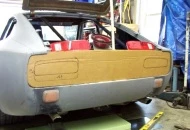
Once the fiberglass has hardened, I popped it off the aluminum, turned it over, and now I have a rough piece of the tail light panel.
Fiberglass work
The license plate recess is laid, hardened and bonded onto the the tail light panel.
Fiberglass work
Mounting stubs are bonded onto the back side of the tail light panel. These have threaded holes in them and are used to attach the panel to the car using the OEM mounting points.
Fiberglass work
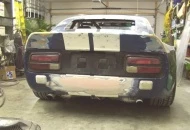
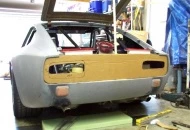
Tail light panel (with license plate recess) is attached to the car with the tail lights installed.
Fiberglass work
A Buick LaSabre tail light lense is cut up and used as a secondary cover over the Ford tail lights to give the tail lights an even prismatic appearance. The greatly enhanced the appearance of the Ford truck tail lights.
Fiberglass work
A splitter was fabricated so that the tail lights would have a wider, lower appearance, and to also "mask" the Ford heritage.
Lower panel for the Fuel Cell
Now to cover the ugly fuel cell, battery box, and exhaust pipes from view.
Lower panel for the Fuel Cell
Once again, aluminum sheet was used as a mold. The piece was cut to shape, and then hammered into the correct curves.
Lower panel for the Fuel Cell
While the glass was still wet and soft, I propped it into place with some old lacquer thinner cans.
Lower panel for the Fuel Cell
Once the glass kicked, I removed it, popped it off the aluminum, and it is ready to finish
Lower panel for the Fuel Cell
The sanded and primed lower panel. This panel is held on by six sheet metal screws and two 1/4" bolts.
Lower panel for the Fuel Cell
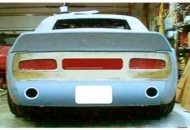
Lower panel installed onto the rear bottom of the car. The exhaust cut-outs are next. I cut tow holes in the rear panel which will be where the exhaust will exit.
Lower panel for the Fuel Cell
1/8" aluminum rings were cut out and hammered into the correct compound curves that match the rear panel's shape.
Lower panel for the Fuel Cell
The rear panel needed to allow some air venting to keep the fuel pump cool, and allow air past the differential. I started with an Acura front grill as a means for creating a rear vent.
Lower panel for the Fuel Cell
And then a fiberglass frame was fabricated to hold the newly modified Acura grill.