1955 Chevy Gasser spotted at Lowes Parking Lot
March 1, 2010 by Hechtspeed · 2 Comments
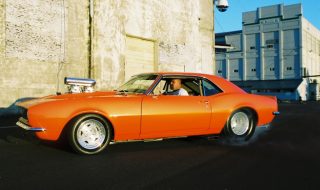
So, February in Utah isn’t a great time to bust out the street driven Gasser, you’d think, but the owner of this ‘55 Gasser called “Hemi Hunter” gets a big high 5 for doing just that. Of course, it is the warmest day since November 22, it was a balmy 46. Ha ha I’ve got no info except for the pics I took. But its a gorgeous example of an early 60’s Gasser built to run on the street.
This car was immaculate! Cherry black paint, all the correct Gasser mods, like radiused rear fender, bumperless, big long tube headers, no front fender wells to block the headers and straight front axle. Those keystone mags set the car off nicely as well. Rad!!!
“Hemi Hunter” is right, that’s what a 502ci big block will get ya.
Love the gold lettering. Period correct and Rad!
Super clean, that’s the word that comes to mind. I dig the scoop sittin’ under the vette hood bulge.
That paint is reflecting everything. Wow! Dig that vette hood bulge/scoop and big street meats in the rear!
I dig the white steering wheel and white accents. That interior is so clean! There’s that word again, CLEAN.
…and one more pic for your hot rod enjoyment.
So, all in all, an amazing find for a Saturday morning in February. If you own this ride, comment below and help us with the info and history of this car.
Is that “Barnes and Sperry” name a tribute or is this the same car from back in the day? See this link to Gasser Madness website and let me know if you guys think this is the same car?
Car Interior 102 – Rebuilding Your Seats
January 18, 2010 by GreaseGirl · 1 Comment
Looking at this picture now, I can no longer imagine my original plans were to simply slap some seat covers on and call it a day. I changed my mind when I realized these ol’ seats had been rat-infested and that the majority of my time spent with my car would be sitting in the driver’s seat! Making over my car’s interior was one of the first jobs I tackled alone on my 1955 Studebaker. Whenever I open the door and sit on my plush and sturdy bench seat, I’m thankful that I took the time.
This article is just one of an entire series focusing on how-to rebuild your car’s interior yourself, next up will be Car Interior 103 – Auto Upholstery. Before we get to upholstering, let’s make sure you’ve got a good foundation to put that pretty new fabric on. Following the steps below will get ya ready to ride in style and comfort!
1.) Pull the seats out of your car.
You can’t very well work on those seats while they’re still inside the car! This job is easiest when you’ve got plenty of room to work. Having a friend to help with the lifting is a big bonus too!
Most every seat is going to made a differently, so spend some time observing how yours are put together. In my car, I have to slide out the bottom seat parts before being able to unbolt the frames of the upper seat parts.
2.) If the car floor needs any work, now’s the time to do it.
If you have any floorboard holes or weaknesses, this is the step where you’d want to get them taken care of. You’ll also want to clean it and I would really suggest adding a noise-dampener layer as well.
First I vacuumed and mopped up debris then followed with a good degreaser such as Purple Power. To stop a small amount of rust that had began, I used a rust-stop chemical. Then I was ready to apply the noise-dampener. There are many different noise/temperature protectors to choose from ranging from brush on (like I used) to cut & tape. These vary in price and quality, so now what your needs are and look around.
3.) Strip the seats down to the frame.
It’s demolition time. I found it helpful to take pictures along the way – so when I got curious about how something was originally put together later on during this process, I had hard proof of it!
First I tore apart the original upholstery and unlayered the levels of padding. If your upholstery is in good enough shape to use as patterns for next time, be very careful in handling it. Keep all upholstery in solid pieces, using small scissors or a seam ripper to separate each piece. When all this is finished you should have a bare metal frame with springs and other foundational elements attached (many cars may have some sort of burlap/jute underlayer also.)
4.) Do necessary mending to seat frame.
I didn’t have any problems with my seat frame in its original condition, so you’ll have to be the judge on your project. However, if springs appear to be out of place or there is excessive rust, you’ll need to do some work on that before refoaming. Sometimes springs can just be re-wired back into the correct position. Other times you may need to replace a spring – or perhaps the entire seat.
If you’re putting a different seat into your ride, be sure to take very good measurements. It needs to fit inside (with doors closed) and put you at the correct ride-height when driving.
5.) Get your foam ready.
As much as I can tell, everybody uses foam material to build seats with nowadays. The stuff that was on my seats originally was a small layer of foam with a larger layer of cottony stuff on top…but to replace it I used only foam. This can be purchased at a car upholstery supply shop. I was able to find one within 20-miles of my house by checking internet listings.
Bring a picture of your project along with you, so the people working in the shop can best advise you on what materials you’ll need. Or, like my friend Luis said, discuss your project with a professional car-interior person and they’ll probably have tips, suggestions, and resources for you. (For example, MyRideisMe member MikeyBigBlock has offered to answer upholstery questions!)
The supply shop I went to advised I use 2-layers of thick foam (although 1 probably would’ve worked better) covered with 1-layer of thinner, less dense foam.
6.) Rebuild your seats with the new foam.
Paying attention to where padding was at on your seats when you took them apart, reapply the new foam. On my seat-bottoms I used 2 layers of thick foam – using upholstery glue to hold them together (although don’t depend on the glue to hold.) The upper-seats only got one layer of thinner foam. This foam needed to be wrapped around the top and sides on my seats. I made this work by cutting a triangle shape out of the foam at the top corners. Remember that ultimately it’s the upholstery that is going to keep everything in its proper place.
When all the foam was on, I used a razor blade to round off the front bench seats edges. Take great care in ensuring that the foam is smooth in all areas. If there’s a bump or ledge anywhere, it’s not going to disappear when you put upholstery over it!
7.) If you haven’t already done it, choose your fabrics and get ready to upholster!
There is a lot of variety in car interiors. If you need any help planning out what color scheme or look to give your car interior – take a look around at various cars interior’s during your next car show. They range from single, solid color to fancy patterns and more.
I’ll be talking more about choosing your fabrics and upholstering your seats in my next article, Car Interior 103 – Auto Upholstery. If you have any questions or suggestions, leave a comment below…until then, good luck and happy trails!
Car Interior 101- Redoing a Classic Car
January 4, 2010 by GreaseGirl · 6 Comments
Happy 2010!! Now that the holidays are over, it’s time to get down to business! And for Grease Girl that means giving you more of what I originally set out for…to help the beginning car person get involved in the garage! While I hope my Studebaker wish list will provide the topics for some great how-to articles over the coming months, I’ve got a few tech how-to’s up my sleeve already.
Next to mechanics, paint is priority for most. However its my opinion that interior is more important, particularly if its a daily driver. Far more hours are spent sitting on the inside than viewing the paint outside, right!?! So what better place to start this year off than with the very first job I tackled on my Studebaker – the interior!
Get ready for a whole series of articles this month on redoing your classic car’s interior. Before jumping in, I thought I’d start with a few tips from a pro. Luis Loyola was kind enough to have me over to his shop, Loyola Auto Interiors, and share with us some terrific expert advice.
So sit down, relax, and get ready to get to work!
http://www.vimeo.com/8510085Salt Flats Speed Shop: Traditional Hot Rod Builder
December 25, 2009 by Hechtspeed · 4 Comments
Salt Flats Speed Shop in Orem, Utah is run by Chris Davenport, a metal fabrication and finishing craftsman and hot rod builder who is dedicated to building 1930’s traditional hot rods. Chris has been in business officially for about 2 years now and is attracting more and more customers as the word gets out about his affordable, high quality craftsmanship.
“Need a Chop, a roof insert, fender, or a quarter panel? Well you’ve come to the right place. We’ll fix all your cars issues, and have it looking as good in “bare metal” as it did when it was made.”
Chris (in the white shirt) showing us around his shop in Orem. This is a customers 3 window coupe with suicide doors. We dropped in on Chris Thanksgiving week. He willingly took an hour or more to give us the full shop tour. He explained all his tools, showed us all his projects and talked shop. I could tell Chris is passionate about hot rods!
I had emailed Chris letting him know that a friend and I wanted to drop in and check out his shop. My friend, Gary, has a 1928 Model A Pickup of his own and found Salt Flats Speed Shop on the Jalopy Journal forums, which is where I originally spotted Chris’ handy work as well.
I checked out Chris’ website saltflatsspeedshop.com and was amazed at the craftsmanship and skill involved in the metal repair and custom fabrication I saw in his projects page.
Chris is building his own Salt Flats Speed Shop 1932 Model A Tudor Sedan to show off what he can do. Please take a few minutes to see his detailed H.A.M.B. ‘32 Tudor build thread. My favorite project at the shop was Chris’ ’32 Tudor. If you’re subscribed to the build thread like me, you’ll know that he’s planning on taking the car to Speedweek 2010 and actually racing on the Salt. Chris has period correct frame and body modifications underway, including a 4.5″ to 5.5″ chop top (amount of chop not totally decided), a ‘32 pickup grille, schroeder steering box, ‘40 Ford steelies with dirtrack Firestones and a hot 8 BA Flathead V8 with a race cam, Edelbrock heads, an Offy 2 carb intake setup and 5 speed behind it (hey, might as well take advantage of modern tech’ for better mpg and driveability).
To build an old school hot rod, you gotta have old school metal working tools. Let’s take a peek at Salt Flats Speed Shop’s tools of the trade shall we…
Here are just some of the metal working tools used to perform any number of repairs or fabrication. Close up of an English Wheel (used to put a crown in a door skin or roof insert), standard millin/drilling station and a Lenox Nibbler (Louvers, shrinking and shearing and beads).
I liked this shelf hanging on the wall full of rolling dies in many shapes and sizes. Chris said he can replicate any body line from the 20’s, 30’s and 40’s with his equipment.
Chris is doing some restoration and repair (R&R ha ha) on a friends Porsche project. Cool rotissiere stand! Chris made that too! Obviously!
Here’s a look from one end of the shop to the other to get a look at some of the project cars. You’ve got the 32 Tudor, a 3 window coupe, the Porsche, the aluminum 1940 Willy’s (that’s right, aluminum) and another 3 window coupe. So cool! Lots of bare metal in this shop!
I believe most of these are spoken for, but that is a nice collection of Model A Pickup cabs ready to be turned into hot rods.
This last picture is cool. A closeup of the die set on that Lenox Nibbler that will do wonders with a flat sheet of steel.
So there you have a quick glance at Salt Flats Speed Shop. Check out their website and 32 Tudor build thread. I hope to bring more of the ‘32 Tudor to MyRideisMe.com in 2010.
Go and visit theSalt Flats Speed Shop Website
Hechtspeed
“Internet Barn Find #11″: Sandy’s Soda Can Hot Rod Masterpieces
December 17, 2009 by Hechtspeed · 1 Comment
This is probably the coolest Barn Find to date. I’m not gonna talk much on this one, because it will take up too much space where pictures should be. Please check out this website.
Looks like each car can be purchased for $2000. Heck, if you’re crazy enough, you can purchase his drafting plans for $10/ea to build your own. Good luck though, because you’re going to need serious craftsmanship to build it.
Here’s the website: Sandy’s Can Cars
You’ll be blown away, I was!
“Internet Barn Find #10″: Burkland’s 400 MPH Streamliner
December 14, 2009 by Hechtspeed · 1 Comment
Dallas Volk, my Salt Flats insider, sent me this link. He is good friends with the Burkland family. I knew I needed to share their website with you all. This post does come with some sad news, that Gene Burkland has passed away this week. I mean this post to be in deep respect and a tribute to Gene and his family’s great history at Bonneville.
The Burkland Streamliner is a twin Donovan Chrysler powered, 4 wheel driven racecar that has gone over 400 mph. Please take a look at their website HERE as it is full of pictures and information, as well as links to other Land Racing websites and stories. This blazing fast Streamliner was designed and built by Gene and his son Tom Burkland. If that’s not “My Ride is Me” I don’t know what is…Here’s a quick blurb from the site about the Burkland family:
“Gene and Betty Burkland, from Great Falls, Montana (the first SCTA members from that state), have been active in racing, and at Bonneville in particular, for over three decades: their first Bonneville car was a chopped-top, Chrysler-powered ‘53 Studebaker Competition Coupe, with which Gene set a record in A/BFCC at 255+ mph in 1978 (this car was recently restored to racing condition and ran at Speed Week in 2000 and 2001).
As soon as he grew old enough, their son Tom joined the team, and promoted the building of their next car, a Datsun-based, Chrysler-powered, ground-effect Competition Coupe, which allowed him to set a AA/BFCC record at 294+mph in 1985.
Around that time came the idea of building a streamliner, which took all of the next ten years to become a reality.
As much as the finished car looks like a fairly sophisticated, high-tech, million-dollar job, it is in fact strictly a family effort: in true hot-rodder tradition, it was home-built using generous supplies of the most precious materials available at no cost: skill, hard work and enthusiasm, plus a little help from their friends!
Then of course, Tom’s experience as an aerospace engineer (he worked on F-16’s) was a key factor in the design of the streamliner…”
Do yourself and favor and browse the site for a few minutes, you’ll be inspired!
Hechtspeed
Wrench Like A Girl – Video #1:Distributor Wires
September 15, 2009 by GreaseGirl · 3 Comments
Since sometimes its easier to “show” then “tell” I’ve decided to make some videos on tech issues when they come up with my 1955 Studebaker Champion. So without further adieu…here’s my first in the “Wrench Like A Girl” series…let me know whatcha think!
Topic: I’ll be changing out the distributor wires (aka ignition wires, spark wires).
Diagnosis: This problem was first brought to my attention by a friend who pointed out the gaping hole in the wire casing. And only then did it really register how uneven my idle was and how much power I’d lost in my engine! Keep in mind that these wires are carrying the electricity into the engine. Without these babies there would be no spark to ignite the gas within your engine chamber! Due to my damaged wire, my engine was not firing on all 8 cylinders – no bueno!
Parts: I picked up a new set of ACDelco wires from C&C Automotive Distributors in Long Beach. Cost: $40.68
Tools: Really just the new parts and your hands. I also needed an Allen wrench to undo the hex bolts on the part that was keeping my wires organized – as well as a couple new zip ties to keep the new wires away from my roomy headers – and a wax pencil or something like that to label the boots to their corresponding spark plug (this doesn’t have to be done, as they’ll be changed 1 at a time…but it was a 2nd security measure for me).
Time to do it: 1 hour. Could be less,but since I had those special wire holders it took some extra time.
Afterwards: Stude ran much better. I had alot more power and my engine no longer sounded out-of-synch. Some people have mentioned I should get the fiberglass socks that slip over the engine-end of the wires to protect em’ from heat…I will keep this option in mind – but call me vain, I just don’t like the way they look!
P.S. Hope this was helpful! “Wrench Like A Girl” is by no means trying to say girls don’t wrench as well…but rather, that we ladies may not have as much experience! So send your beginning-wrenching (or wanting to) friends over this way…whether they’re guys or gals!
Scopin’ Out Ken Scobies 1934 Ford
July 23, 2009 by GreaseGirl · 2 Comments
It was an early morning wandering around the quaint streets of Stevensville, Montana. The last thing I expected to see was a slammin’ 1934 Ford Hot Rod Pickup. If it wasn’t for my own pre-morning-coffee-haze I would’ve gone into the Full Moon Saloon and inquired who the owner was. Lucky for me (and you) that I ran into this pretty truck along with its owner Ken Scobie, once more that evening at the Stevensville Summer Picnic & Car Show.
With 2 trophies under its belt in a mere 4 weeks since being completed, this truck is worth giving a peek. Its been built from the frame up by Ken Scobie, a San Diego native that migrated on up to Montana 35 years ago while still working as mechanic. He’s since retired, and at the age of 69 says “For a poor kid growing up in the days of cool rods it has always been a dream of mine to build a rod in the old school style.”
Build a rod he did! “Finding this beauty was the real treat. She was in Helena, Montana behind a house out in the weeds. After two solid years of negotiating, she was all mine.” Taking into account where it came from, it’s surprising that the body had very minimal damage, no cancer, and no bullet holes – which partly accounts for why Ken decided to leave the body in its original state. Besides…I think he likes it that way – regardless of the fact that about every other person commenting on it at the show in Stevensville asked “So when ya painting it?”
Every bit of the work other than some minimal machining to the engine was done by Ken’s own hands. Ken informed me that every piece o’ this baby is a Ford part with the exception of a couple rounded headlights. It’s obvious that this is a guy who knows what he wants…even if he did have to wait awhile to get it. Ken says “I had to wait 75 years but it’s a helluva ride and the chicks dig it!”
All this work took Ken a couple years to finish – and now that he’s drivin’ the 34 around he’ll be startin’ work next on a 36 Ford 5-window coupe arriving from Oklahoma(keep your eyes open for updates on this!) And even way up there in Montana, I’m sure Ken is helped along by his comrades in The Shifters Car Club based out of Lolo, Montana (not to be confused with the So.Cal Shifters.) Ken says The Shifters formed just 3 years ago with 5 guys and has currently grown to over 100 members (girl members included!) So if you ever find yourself up in Montana, give Ken a call and maybe he’ll bring his spunky 34′ over to the Full Moon Saloon and share a beer…if ya can’t make it all the way up there, leave a comment and let him know what ya think!
The Details….
- Owner/Builder: Ken Scobie of Stevensville, Montana
- Car: 1934 Ford Pickup
- Paint/Body: original
- Engine: Ford 268 Flathead – Polished, ported, relieved by owner
- Carb: Dual 97s
- Transmission: 1963 Ford 4-speed side shift converted via Jeep C7 to a top-load floor shift
- Brakes: Disc in front with Chevy Vega cross steer and 3/16th stainless steel lines
- Rear End: Ford 9″ with 3.56 ratio attached via 1936 radius rods and a transverse spring
- Front Axle: Chromed 4″ dropped Bell I beam with Pete and Jake hairpins as well as front and back panhard bars
- Exhaust: hand built with Scotty mufflers
- Fuel: Electric pump with 3/8″ polished fuel line
- Interior: In progress
- Contact Info: kscobie34ford@yahoo.com

Dear Welder Series… four link, sway bar, tig welder
May 13, 2009 by WelderSeries · Leave a Comment
Fabrication, Welding and how-to’s for your home built hot rod from WelderSeries.com
Dear Welder Series…
I have a 1956 Chev truck and want to put a 4 link in the back .was thinking of a triangulated one. would that work? the frame is 34 inches wide.or should i use a parallel 4 bar and a panhard bar and which kit # do you recommend ? thank you Dave
Dave, this is a good question… There are several considerations when choosing a rear suspension system.
An important one is frame width.
A typical triangulated rear 4-link has the upper bars mounting off of the frame boxing plates and angling back to each side of the differential housing. The narrower the frame, the less triangulation is possible unless the upper bars get shorter. Shorter upper bars cause greater pinion angle change. The upper bars could be angled from wide apart on the axle tubes to close together off of a crossmember to get more triangulation.
A parallel 4-link and Panhard bar is not as sensitive to frame width. The bars should be mounted as wide apart as practical to stabilize the rear end.
The triangulated system requires more precise installation. It costs less because there is no Panhard kit
The parallel 4-link/Panhard system allows adjustment in any direction with a minimal effect on other settings.
Both systems can cause problems with exhaust routing.
I recommend the parallel kit because it’s easier to install and easier to set up.
Thanks for writing. I hope we can help with your project.
Paul Horton
Dear Welder Series…
Do you make your universay sway bar in 0500 inch diameter. The 48 Plymouth Conv I’m working on never had a rear sway bar and I may not be able to use anything greater than .750 on the front.
Bob, all of our sway bars are .75″ diameter. The outer tube, which serves as a bearing (urethane bushing) holder and a place for the mounting tabs, is 1-3/8″ O.D.
Dear Welder Series…
Specifically I’m looking to get into a tig setup for the first time. Would a Miller Maxstar 150 be powerful enough to do the nice (and quick, I might add!) tig welding I see being done on your videos?
Thanks, Scott
Thanks for asking me about this welder, Peter. I’m not familiar with it, but it seems light. Here is a forum thread that I’ve been following that might be helpful: http://canadianrodder.com/forum/showthread.php?t=3206
I know Mike (Oldman) and respect his knowledge. (He’s a heck of a good guy, too.)
I hope this helps.
Paul Horton.

3 Steps to Personalizing your Hot Rod
December 22, 2008 by pikesan · 7 Comments
I’ve always liked my car… Good thing, right? I guess I always wanted a hot rod. Bonnie, as in Bonneville, sure has changed since I bought her at a Goodguys show. The 3 pictures shown here are the 3 evolutionary changes of the car.
Step 1: As I bought her: I was thinking of buying a Zipper bodied Lakes Modified until I found out there’s a 6 month wait to get one. I felt pretty lucky to grab this when I did.
You’ll see the long split wishbones hooked to a 3 inch dropped axle. The rear axle is a old school banjo. The wheels are the 1935 style wires with some hard as hell bias ply or tractor style tires. I’m not sure what kind of paint the original owner used, but that yellow is tough as NAILS!! The engine block hasn’t never changed, but it did get updated. I’ve got the original header on it too. The quarter elliptical spring suspension front and back is there, but there’s friction shocks (only better then nothing at all!) in the front and nothing in the rear.
Step 2: My Redo: Since I was never a fan of the wires, even on lakes-style modifieds, I went to 15 inch steelies with wide white walls. I’ve always (like so many other people) liked the look of a red wheels with a white wall. It’s classic. I went to radials too. The front and rear suspension was updated. The front cause I had to. The axle had a crack in the passenger side king pin bushing. If that would have failed, the wheel comes off. NOT good. I changed to hairpins front and back too. I like the look of the wishbones, but setup the way they were, the rear axle is bound up. I found a pretty nasty crack on one side where the rear wishbone mounted. The rear axle is now an 8 inch with a 4.11 gear. I installed shocks front and back too. There’s alot of pictures of the front and rear suspension in my garage. I built the head from 1/2 of a small block Chevy kit that I split with a dude on Ebay. The red paint lasted about 30 minutes. Still, no interior.
Step 3: How she is now: Well, as Bonnie gets closer to being a “finished” car, the less interested I am in her. I still like this car, but I find myself thinking of building/working on my 63 Falcon wagon and 61 Rambler American wagon more. Maybe I’m getting old?
In the latest incarnation, I went to 16 inch steelies with Firestone bias ply tires. The ones in the back are TALL! It has a little more rake to it then I’d like, but nobody else thinks so. I made a new header a while back, but that’s changed since step 2. There’s more pinstriping on her now and I’ve added the custom MyRideisMe.com piston logo to the door. My buddy Joel from 1320 Designs hand painted it for me. We’re still planning to “antique” it a little. Last but not least, the interior’s in it. More on that later.
What do you think? Which one’s your favorite? Have I made steps forward or back? It’s all a matter of taste, but that’s what makes My Ride is Me, right?
Please join MyRideisMe.com and get your own Custom Garage Space (that one’s mine!) to put pictures of your car, project or whatever you’re driving!